


Deception And Truth Analysis, Inc. has spent almost a decade working with deception scientists and studying multiple methods of deception and truth detection. Based on this knowledge we developed Deception And Truth Analysis, a proprietary algorithm based on scientific research and making use of textual data to rapidly identify deceptiveness in business communications.
A practical demonstration of its power is our recent work where use of D.A.T.A.’s algorithms were able to identify 9 of the top 10 biggest corporate scandals of all time, costing investors $144.3 billion, with an average lead time of 6.2 years. The following tables demonstrate the analysis:
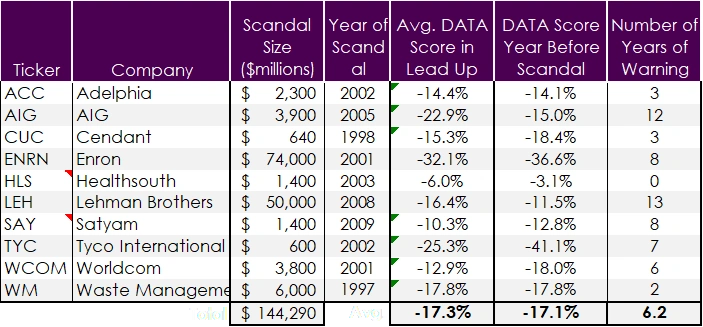
D.A.T.A. Scores range between -100 and +100 with any negative score indicating deceptiveness and any positive score indicating truthfulness. As you can see in Table 1 the average D.A.T.A. Score in the lead up to the Top 10 scandals becoming public was negative for all ten companies.
Our headline for this Case Study is that we identified 9 of the top 10 biggest corporate scandals of all time. Technically, however, we also assessed Health South as likely being deceptive. That said, we think the case of HealthSouth is noteworthy and requires a deeper dive. Here’s why…
At D.A.T.A. we like our analyses conservative. Health South’s scandal was based on fraudulent accounting starting in 1996. Their D.A.T.A. Score that year was -15.7%, an accurate indication of deception. However, the scandal itself did not become public knowledge until seven years later in 2003. The trend over those years was D.A.T.A. Scores that always indicated deception, but weak deception. We fully recognize that many investors were likely to see the improvement as a sign of improving governance at Health South and may have invested. For that reason we do not include Health South as an instance in which D.A.T.A. would have provided an assist to your investment due-diligence.
We believe using Deception And Truth Analysis in a time series makes sense because investors are able to see fluctuations in the level of deceptiveness and truthfulness of a company. Here are the scores for the Top 10 Scandal companies in time series:
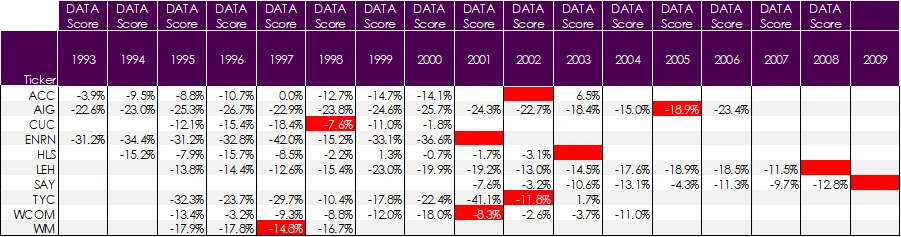
Note 1: Red boxes indicate the year in which the scandal became known to the public.
Note 2: Some of the businesses did not file electronic annual reports on EDGAR until the mid-1990s.

0 Comments