
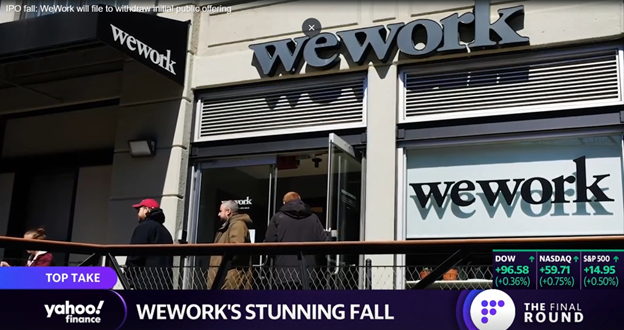

The We Company, more popularly known as WeWork, is now a public company. But you may remember that it yanked its original attempted IPO on 30 September 2019 among many investor concerns.[i]For us at Deception And Truth Analysis (D.A.T.A.) this makes for an interesting case study in the powerful combination that is a knowledge of deception science and natural language processing.
The We Company is also an interesting case study because its overall level of deceptiveness in its S-1 rates it as truthful. But key sections within the document score as highly deceptive. Not only did D.A.T.A. identify the key issues present, but according to an insider at The We Company we also identified another key issue hotly debated internally at the company never identified by the investment community or public. Read on to hear more about the details of our assessment.
The We Company IPO Background
When The We Company pulled its IPO on 30 September 2019 it was sparked by a credit ratings downgrade by S&P Global on 26 September 2019[ii] to B-. Of their downgrade S&P Global said:
“The downgrade reflects heightened uncertainty around The We Company’s ability to raise capital to support aggressive growth and the pressure this places on liquidity…These uncertainties stem from the weak reception of The We Company’s IPO, partly related to what we view as subpar governance practices.”
The We Company had originally issued its S-1 on 14 August 2019. Thus, by the time of the company withdrawing their IPO, investors had 47 days to assess WeWork’s S-1 before the S&P downgrade sparked its meltdown.
But Clients of D.A.T.A.’s twin products DATAbase[iii]and DATAREDline[iv]would have had each of the key issues that The We Company management team was being deceptive about identified for them in the 387 page[v] S-1 available in less than a minute.
By comparison, for an analyst to have done the same would have taken approximately 13 hours of work.[vi]Additional research demonstrates that experts attempting to surface deception in documents have an accuracy of just 50.0%.[vii] D.A.T.A.’s double-blind scientifically tested accuracy by comparison is 88.4% and our speed means that our products are a research team force multiplier.
Here is what we found in The We Company S-1 dated August 14, 2019:
- An aggregate D.A.T.A. Score for the entirety of the 387-page document of 22.7%, on average truthful. Our scores range between -100% and +100% with any negative score indicating deception present in the language, and any positive score indicating truthfulness present in the language.
- Despite being, on average, truthful, crucially 34.9% of the We Company S1’s fragments scored as deceptive. In other words, “analysts beware!”
- Several We Company S-1 fragments scored alarmingly high, with the most deceptive fragment assessed at -46.7%, highly deceptive. The second most deceptive fragment was not too far behind at -46.5%.
Below is a screenshot of our DATAREDline Report[viii]where you can see our D.A.T.A. Scores as they roll through the entirety of The We Company S-1:
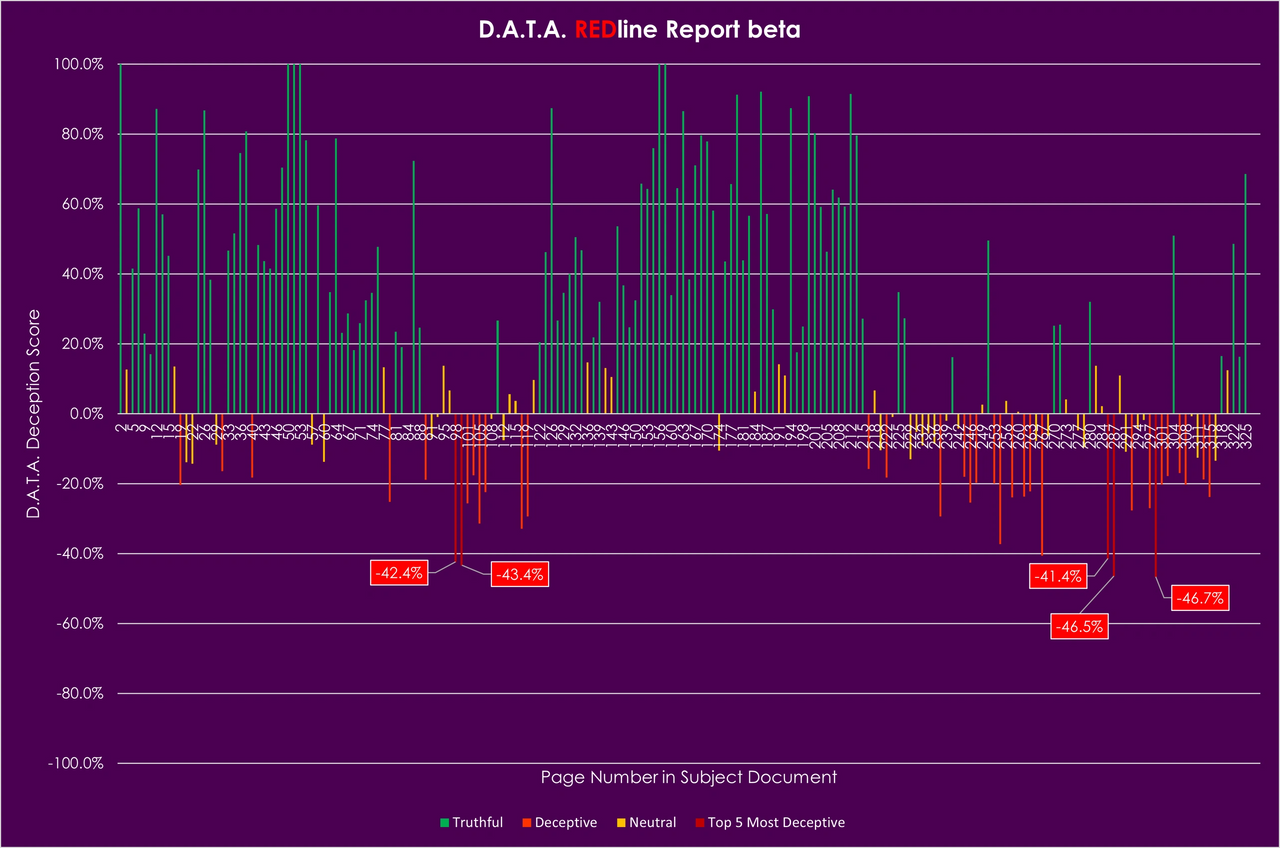
For The We Company S-1, the overall score, as we discussed is truthful, or 22.7%. But within the entirety of the 300+ page document there are many fragments that score as being deceptive. It is natural to ask what is the text associated with each of those scores, yes? So let’s do a deeper dive into our assessment.[ix]
D.A.T.A.’s Interesting Results: The We Company’s 11th Most Deceptive Fragment
Why do we wish to draw your attention to The We Company’s eleventh-most deceptive fragment, assessed at -29.4%? Because this is the section that specifically discusses the company’s relationship with Softbank and Softbank being a principal stockholder in The We Company. This issue was described by S&P Global in its downgrade:
“[The] downgrade does not take into account any additional investments from SoftBank other than the $1.7 billion coming in 2020.”
In other words, D.A.T.A. was able to identify within seconds the most important issue for investors that ultimately led to the S&P downgrade which, in turn, led to the IPO being pulled. However, we also believe we uncovered additional and critical information never before understood by the investment community and that scored as more deceptive than this key section.
D.A.T.A.’s Interesting Results: The We Company’s 2nd Most Deceptive Fragment
This fragment’s D.A.T.A. Score was -46.5% and ranks as The We Company’s second most deceptive fragment. It comes from pages F-85 to F-88 in the S-1 and discusses the company’s sources of “Other Revenues,” contracts with customers, and the company’s operating lease arrangements. To our knowledge, the content of these sections was never a part of why investors soured on The We Company’s IPO.
D.A.T.A.’s Interesting Results: The We Company’s Most Deceptive Fragment
Most deceptive of all of the fragments is the one on pages F-102 to F-103 of the S-1 whose D.A.T.A. Score is -46.7%, or strongly deceptive. Importantly, this text was buried in small print to footnote 11 of the S-1.
To summarize the content of this fragment, The We Company’s most deceptive, they have to do with the various joint ventures entered into by the firm. These equity investments include IndiaCo, ARK Master Fund, the WPI Fund, and The Wing. Interestingly, the content of these fragments were never publicly highlighted by S&P Global or by other investors to our knowledge. However, a WeWork insider has confirmed that the company’s relationship to the ARK Master Fund was hotly debated internally. See below for more details.
D.A.T.A.’s Interesting Results: Confirmation from a We Company Insider
A We Company insider at the time of the 14 August 2022 S-1 has confirmed the importance of the ARK Invest assessment, confirming in an e-mail:
“I went through your analysis of the WW S-1 filing.
“During my time at WeWork we had a lot of discussions around the then pending IPO and WeWork’s largest shareholder [i.e. Softbank].
“The inception of the ARK Master Fund at the time led to multiple critical conversations around the topic. The CEO had previously leased buildings he owned to WeWork. While the argument was made that it helped to facilitate a proof of concept for the business, it was seen critically by some, as it could be viewed as poor corporate governance by public market equity investors in a potential listing. Separately, the increased reliance on Softbank was discussed. It was evident that while the interest on the Softbank warrant was high, financing from an alternative source was likely less accessible.”
This confirmation is in addition to the multiple other forms of validation that we have done in testing Deception And Truth Analysis.
D.A.T.A. is a Powerful Assist
Evaluating IPOs of newly minted companies is an especially tough job for investors who frequently lack much historical data, or a way of judging companies that are creating entirely new industries. For prospective investors engaged in due-diligence of The We Company it is almost a certainty that their time was spent assessing:
- Qualitative content such as WeWork’s opportunity set, business model, and governance structure. Despite these efforts it is likely that these qualitative assessments lacked scientific rigor in drawing key conclusions on things such as the trustworthiness of Adam Neumann, WeWork’s charismatic founder, and the governance checks on that power from the likes of large shareholders like Softbank.
- Quantitative content such as its three-years of income statements, truncated balance sheet, and the information contained in sections like Our Story.
It is likely that most of the analytical firepower by investment pros was spent here, but the quantitative content of the S-1 made up just 1.31% of the total content of the document. This is just slightly below the average investment regulatory document which features 1.7% of information contained in numbers.
In other words, most investors in their evaluation of WeCompany were likely doing what most pros are stuck doing: looking for their keys at night under the street lamp (i.e. examining mostly the numbers); not because they lost them there, but because that is where the light is (i.e. all of their education about investment due-diligence). In short, there is a lack of scientific methods for assessing the 98.69% of financial documents that is textual data.
By contrast, imagine the power of a research team assisted by D.A.T.A.
Conclusion
If D.A.T.A. Clients had been confronted with The WeCompany’s S-1 on 14 August 2019 they would have known in seconds what it took the rest of the market weeks to figure out. Just to read all of the S-1 would have taken an analyst approximately 13 hours and there is no guarantee that they would have uncovered the deceptiveness contained therein. Scientific research has demonstrated that even pros are only able to surface deception in documents 50% of the time. In addition to the issues identified weeks later by analysts – liquidity, governance, and its relationship with SoftBank – D.A.T.A. also registered as deceptive language about The WeCompany’s relationships to various subsidiaries; issues never discussed publicly among investors.
Endnotes
[i]To keep this article digestible, we are providing links to downloads for the text associated with the deceptive fragments discussed in this article.
[ii]This is a beta version of DATAREDline, our production version may differ.
[iii]Garber, Jonathan. “WeWork pulls plug on its IPO” Yahoo! Finance. 30 September 2019 https://finance.yahoo.com/news/wework-pulls-plug-ipo-145502800.html Accessed on 22 March 2022.
[iv]Garber, Jonathan. “S&P Global Ratings cut WeWork’s credit rating deeper into junk territory amid concerns it won’t be able to meet its growth plans.” Fox Business. 26 September 2019 https://www.foxbusiness.com/markets/wework-cut-deeper-into-junk-territoryAccessed on 13 June 2022
[v]DATAbase is a vast dataset of SEC documents – 10(k)s, 10(q)s, DEF14As, S-1s, many 8(k)s, and more – for every publicly traded company dating back to 2006 pre-assessed for their level of deceptiveness and truthfulness.
[vi]DATAREDline is our premium product that shows the fluctuating level of deceptiveness and truthfulness in documents along with the words and context associated with the D.A.T.A. Scores.
[vii]The We Company S-1 is 387 8.5” x 11” pages. However, D.A.T.A. does not score numbers, such as those embedded in tables. With the tables removed The We Company S-1 is reduced to 326 pages in length.
[viii]Our assumptions matches a common rule in content editing that people can read for comprehension approximately 125 words per minute.
[ix]Kleinberg, Bennett and Bruno Verscheure. “How humans impair automated deception detection performance.” Acta Psychologica 213 (2021)
[x] This is a beta version of DATAREDline, our production version may differ.
[xi] To keep this article digestible, we are providing links to downloads for the text associated with the deceptive fragments discussed in this article.

0 Comments