

Deception And Truth Analysis (D.A.T.A.), Inc. has spent almost a decade working with deception scientists[1]and studying multiple methods of deception and truth detection. Based on this knowledge we developed Deception And Truth Analysis, a proprietary algorithm based on scientific research and making use of textual data to rapidly identify deceptiveness and truthfulness in business communications.
Our Methodology
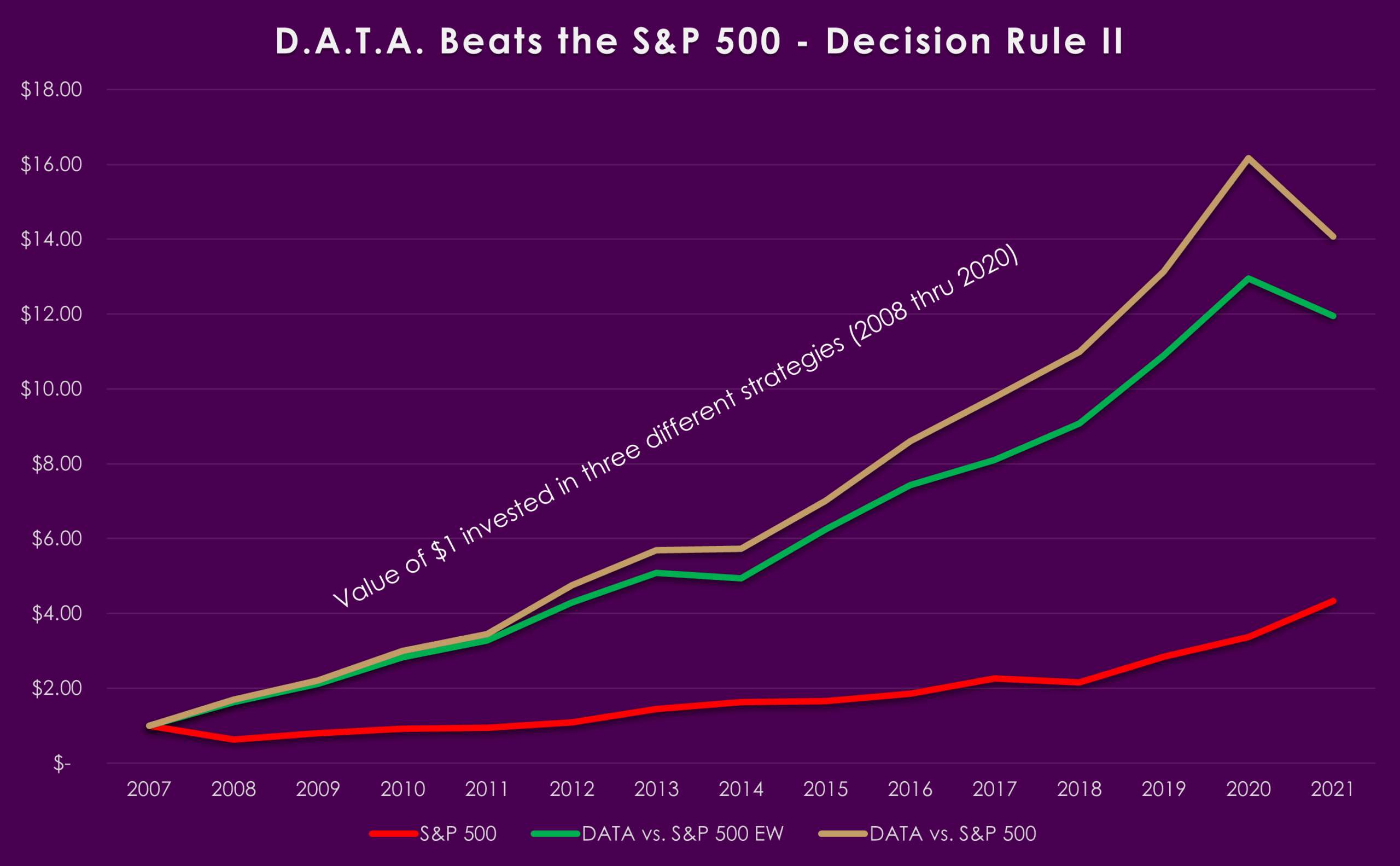
A practical demonstration of its power is our recent work where use of D.A.T.A.’s algorithm was able to best the performance of the Standard & Poor’s 500 Index. Using the 500 components of the S&P 500 we created a simple decision rule: whenever a new 10(k) is published score it for its level of deceptiveness and truthfulness and if its resulting D.A.T.A. Score is greater than 18% (i.e. approximately one standard deviation above the mean)*, purchase it. Hold for a year. More specifically the methodology is, as follows:
- Starting with 2008 and continuing through 2021 each of the 500 S&P 500 components’ 10(k)s were assessed the date of public release by D.A.T.A. to create a D.A.T.A. Score for each firm. DATA Scores range between -100% and +100% with any deceptive score being negative and any truthful score being positive.
- Then, on the publication date of the 10(k) we purchase the company if its DATA Score is 18% or higher. Each of the purchased companies is equal weighted in a portfolio. The average lag from assessment by a D.A.T.A. Score to purchase is less than one day.
- The above decision rule is repeated each year.
- A separate analysis was done where instead of selling a security from the portfolio where DATA Scores were 18% or higher after holding for one year, they were instead held for 5 years. But the methodology was identical otherwise.
Results
Here are the results of our simple decision rule just described:
- Where the strategy is to purchase the firms whose DATA Scores are 18% or higher, equal weighting each:
- Annual average outperformance of 164 bps for a compounded total return advantage of 21,185 bps (2008-2021), with a standard deviation of 3.59%. This comparison is our equal weighted holdings vs. equal weight S&P 500. Note: results against the actual S&P 500 are quoted below; and they are much higher.
- Outperformance in 10 of 14 years (2008-2021).
- Worst performance is -5.21% in 2021.
- Best performance is +7.13% in 2012.
- Where the strategy is to purchase the firms whose DATA Scores are 18% or higher, equal weighting each at the start of each year and hold for 5 years:
- Average rolling 5-year outperformance of 19.95%, with a standard deviation of 12.10%.
- Outperformance in 10 of the 10 five-year rolling periods.
- Worst performance is +2.74% for the five-year period 2017-2021.
- Best performance is +46.72% for the five-year period 2008-2012.
- If a direct comparison is made of our strategy against the actual S&P 500 returns (i.e. not equal-weighted S&P 500), the results are, as follows:
- Average annual outperformance of 939 bps for a compound total return advantage of 97,416 bps (2008-2021), with a standard deviation of 33.13%.
- Outperformance in 9 of 14 years (2008-2021).
- Worst performance is -4,165 bps in 2021.
- Best performance is +10,614 bps in 2008.
- <Aside: equal-weight is a badass strategy.>
- The results reported in #1 our summary above are first pass results and are not optimized in any way. An example of optimized results would be to relax the minimum threshold DATA Score of an arbitrary 18% and to instead find the threshold that maximizes the return advantage of the decision rule. If we did that the results would be to only purchase firms whose DATA Scores were 12% or higher.
- Annual average outperformance of 212 bps (2008-2021) vs. 164 bps for the simple decision rule of only buying companies whose DATA Scores exceeded 18% whose results are shared in #1, above. Purchasing those companies whose DATA Scores are 12% or higher results in a compounded total return advantage of 33,577 bps vs. 21,185 bps for the simple decision rule (2008-2021), with a standard deviation of 1.38%.
- Outperformance occurs in 13 of 14 years (2008-2021).
- Worst performance is -25 bps in 2015.
- Best performance is +500 bps in 2017.
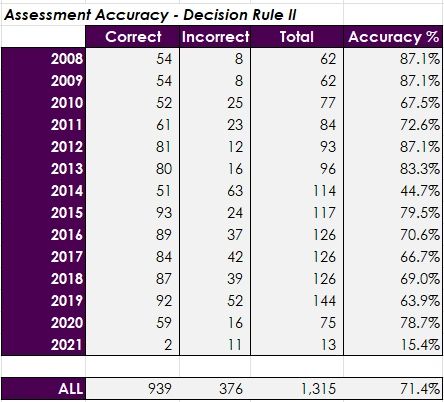
- The number of companies in the S&P 500 each year that meet the decision rule criteria of having a DATA Score of 18% or greater fluctuates. Thus, it is important to know the number of companies that meet that criteria each year so that investors may be assured of being able to execute such a strategy. Here are the number of companies that meet the criteria each year (2008-2021):
Outperformance of such magnitude consistently occurring for multiple time-periods, in some of the most liquid and covered stocks in the world is noteworthy. Additionally, the DATA Scores utilized were for the entire 10(k) and not just the more extemporaneously authored MD&A section.
Note:
- No other analyses were applied, just a run of each S&P 500 components’ 10(k)s through D.A.T.A.’s algorithm.
- The D.A.T.A. algorithm was developed out-of-sample and based on how people pan culturally deceive using language, and not developed in-sample based on how businesses deceive through language.
- To avoid overfit, the main reported results are not optimized.
- There is a considerable advantage to equal-weighting, but the scores we report are “apples to apples,” or equal-weight S&P 500 compared to equal-weight S&P 500.
We Would Love to Hear from You
We would of course love to hear from you so that we may demonstrate Deception And Truth Analysis (D.A.T.A.) technology for you and demonstrate the many practical uses beyond alpha-generation for you and your research team.
[1]See Jason Apollo Voss CFA’s Lie Detection Guide: Theory and Practice for Investment Professionals, for example.
* Why was 18% chosen? Our mean D.A.T.A. Score is 4.9% and the standard deviation of the distribution of D.A.T.A. Scores is 13.2%, or roughly 18%. Note: from above, in case you missed it, if we were to optimize (and we hate optimized reported results) then our decision rule threshold would be 12%.

0 Comments