


Sadly, Friday, 10 March 2023 saw the closure of Silicon Valley Bank and it came with all of the attendant anxieties triggered by a bank run. Clients of Deception And Truth Analysis (D.A.T.A.), however, would not have been surprised by the forces that shut down the bank. Why? How? The reason is that we have registered high levels of deception at the bank for at least six quarters now.
What follows proves an interesting case study of the power of D.A.T.A. to aid you in your investment decision-making. We are doing something rare in this case study. Namely, we are publishing the entirety of our DATAREDline fragments – our premium product – where we show you the language being used by others that is deceptive (see Appendix 1 and Appendix 2).
This means this case study is longer than most of our others. Forgive us, but we want you to have the same view as our Clients do and we know that your own professional opinion of these fragments is what matters. Thus, we are providing you with the raw stuffs to do your own analyses.
What Got Silicon Valley Bank Into Trouble?
Before we dig in deep let us review the sequence of events that led to the closing of Silicon Valley Bank on Friday, 10 March 2023:
- Federal Reserve continues to raise interest rates. This caused many venture capital firms to dial back the risks they were willing to take in funding startups. These startups made up a large percentage of Silicon Valley Bank’s customers.
- Cash Crunch on Both Sides. Lack of funding for startups causes a cash crunch for many Silicon Valley Bank customers. Thus, they started to withdraw their cash to meet their liquidity needs. These withdrawals were far in excess of both Silicon Valley Bank’s new deposits and their withdrawals. In order to shore up their capital the bank announced earlier this week it was looking for additional capital.
- Silicon Valley Bank Sells Bond Portfolio at a Massive Loss. The bank’s first foray into shoring up its balance sheet was to sell a $2.1 billion bond portfolio on Wednesday, 8 March 2023, that consisted mostly of US Treasuries. Unfortunately, the yield on the securities in the portfolio averaged a paltry 1.79%; a figure far below the market yield for the 10-year US Treasury of 3.9%. In particular, as 5-year Treasuries hovered around 4%, their portfolio of the same yielded just 1.4%. Not surprisingly, the bond portfolio was sold at a loss and that totaled $1.8 billion. Ouch! In turn, this loss led to Silicon Valley Bank needing to find a way to increase its equity capital by $1.8 billion.
- To shore up equity, Silicon Valley Bank announces $2.25 billion stock and convertible debt sale. Thursday, 9 March 2023, saw the bank announce an equity offering designed to shore up its equity capital.
- Key investors in the equity deal back out. Private equity investor General Atlantic had committed to participate in Silicon Valley Bank’s stock and convertible debt sale to the tune of $500 million. However, Future Fund suggested to its clients that they pull their funds from the bank. This caused a further run by the bank’s clients and led to a withdrawal of the capital raise from the market.
- Silicon Valley Bank is seized by regulators. The bank scrambled to find a buyer of the bank and was unsuccessful. Thus, just after 9a Pacific Time on 10 March 2023 the California banking regulator closed the bank and announced that it was being placed into the receivership of the US Federal Deposit Insurance Corporation. According to Reuters, the FDIC said that it is seeking to sell all of Silicon Valley Bank’s assets and future dividend payments would be made to uninsured depositors.
Why Analysis of Earnings Calls is Not Enough
One of the questions we frequently field at D.A.T.A. is whether or not we have coverage of earnings call transcripts. First, we are going to be adding earnings call transcripts to our DATAbase product offering; myDATA Clients may already assess almost any document of their choosing, including earnings call transcripts. But second, the reason people ask us that question is because they believe that the strongest signals from companies come from earnings call transcripts. Why? For two reasons:
- The academic community that has long researched the potential causality between news about a company and stock price performance has focused on earnings call transcripts. This makes total sense because in an academic setting they want to be able to draw firm, statistical, causal conclusions between presumed signal and presumed response. By focusing on earnings call transcripts and the stock price performance plus one day, two days, and/or three days they can more easily conclude that the reason for movement in the stock price is due to the information disclosed on earnings call transcripts. This makes sense from a statistical perspective. But that does not mean that there is not signal in other documents, too (see below, as the answer may surprise you…tremendously).
- One of the things that we have noticed in our work at D.A.T.A. is that deception is slightly easier to read when people are communicating extemporaneously. In answering questions live on an earnings call management teams at companies are clearly being more extemporaneous than when a piece of text has been crafted by multiple authors and then edited. So, it also makes sense that investors – especially those sophisticated enough to do text-based analyses – would assess earnings calls.
All of that said, above, there is something missing from a complete assessment of earnings call transcripts as the standard for analyzing deceptiveness or truthfulness. Namely, earnings calls are management-directed theater. Let us say that again:
Earnings calls are management-directed theater.
The information said on earnings calls by management is not only prepared, but also is rehearsed, subject to critical review and feedback by investor relations consultants, and is not as spontaneous as you might think. This is true even in the question-and-answer section.
By contrast, the information in quarterly and annual reports may seem as if it is less spontaneous, but what is different about these documents is that there are regulatory requirements for exactly what types of information a company must report. This information set is much more comprehensive than what is featured on earnings calls. There is no such regulatory requirement on an earnings call as to the breadth of subjects that must be covered. Thus, a full analysis of a company should include, yes, the theatrical earnings calls, but also its dry regulatory filings.
To demonstrate this point we can look at our Deception And Truth Analysis Scores (D.A.T.A. Scores) for both the Silicon Valley Bank’s earnings call transcripts and its regulatory filings. D.A.T.A. Scores range between -100% and +100%, with any negative score indicating deceptiveness, and any positive score indicating truthfulness. If earnings call transcripts are more predictive of trouble, then we would expect lower, more negative/deceptive, D.A.T.A. Scores.
Furthermore, if we wanted to see if Deception And Truth Analysis could provide an assist in predicting Silicon Valley Bank’s closure then we would need to see how management addressed some of the key issues revealed above in both earnings call transcripts, as well as its regulatory filings. The Key Issues are:
- Issue 1: Interest Rates. How was the company addressing a rise in interest rates?
- Issue 2: Deposits. How was the company addressing a decline in deposits/increase in withdrawals?
- Issue 3: Equity. What was the status of the company’s equity?
Assessment: Earnings Call Transcripts vs. Regulatory Filings
So, what do we find? The graph below shows something quite interesting when we look at the D.A.T.A. Scores for both Silicon Valley Bank’s earnings call transcripts, as well as its regulatory filings. Namely, that the Key Issues identified above, and as reported on by journalists, are much more deceptive in regulatory documents. In other words, the stronger signals are in 10(q)s and 10(k)s, not in earnings call transcripts.
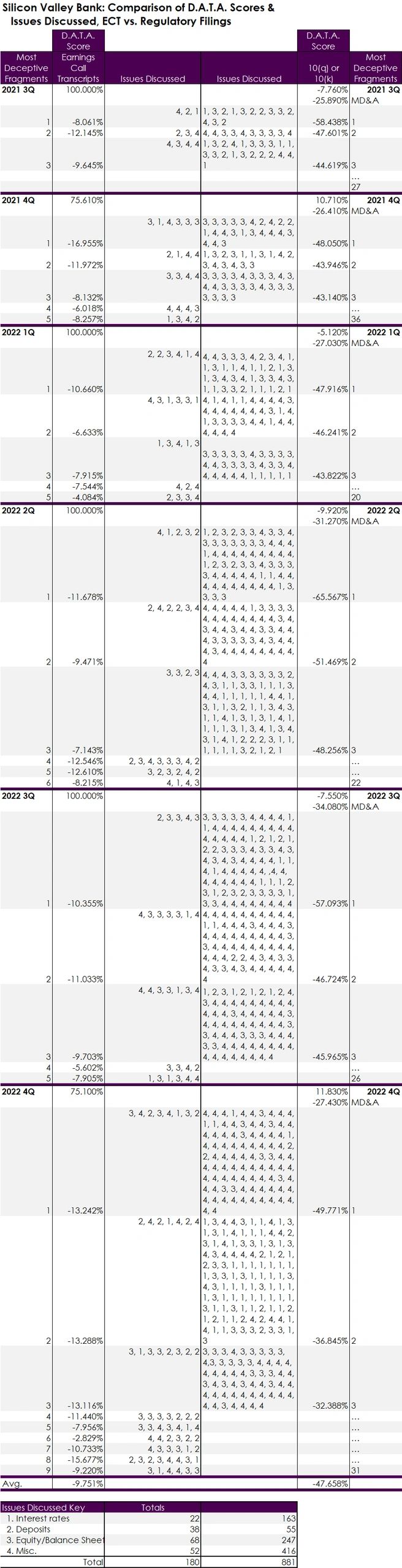
Below a table of our analyses, with the discussion below. A bit of color on the table. The bolded rows indicate the quarter of analysis of either Silicon Valley Bank’s earnings call transcripts, whose data is shown in Columns 1-3, or its regulatory filings, whose data is shown in Columns 4-6. Column 1 also labels the Aggregate D.A.T.A. Score in bolded rows, as well as the labels for fragments of documents that have been assessed by D.A.T.A. as deceptive. For example, Row 2, Column 2 shows a figure of -8.061%, meaning that this section of the 2021 3Q Silicon Valley Bank earnings call was assessed as deceptive. Each row shows the deceptive fragments for each document. Columns 3 and 4 summarize the number of Key Issues that appear in the deceptive fragments.
Earnings Call Transcripts
What you can see in the above table is that, on average, Silicon Valley Bank’s earnings call transcripts have aggregate D.A.T.A. Scores much more truthful than their 10(q) and 10(k) regulatory filings. In fact, the lowest D.A.T.A. Score for one of the transcripts is +75.10%, or strongly truthful [See Column 1, bolded rows].
In fact, for four of the six quarters of earnings call transcripts from 2021 Q3 thru 2022 Q4, the aggregate D.A.T.A. Scores are +100.0%; our highest score. Here is the breakout for the earnings call transcripts:
- 2021 3Q: Aggregate D.A.T.A. Score of 100.00%
- 2021 4Q: Aggregate D.A.T.A. Score of 75.61%
- 2022 1Q: Aggregate D.A.T.A. Score of 100.00%
- 2022 2Q: Aggregate D.A.T.A. Score of 100.00%
- 2022 3Q: Aggregate D.A.T.A. Score of 100.00%
- 2022 4Q: Aggregate D.A.T.A. Score of 75.10%
Regulatory Filings
By contrast, the aggregate D.A.T.A. Scores for Silicon Valley Bank’s regulatory filings for the same quarters is dramatically different, with the highest score being +11.83% and four of the 6 documents score as deceptive in the aggregate [see Column 6, bolded rows].
- 2021 3Q: Aggregate D.A.T.A. Score of -7.76%
- 2021 4Q: Aggregate D.A.T.A. Score of +10.71%
- 2022 1Q: Aggregate D.A.T.A. Score of -5.12%
- 2022 2Q: Aggregate D.A.T.A. Score of -9.92%
- 2022 3Q: Aggregate D.A.T.A. Score of -7.55%
- 2022 4Q: Aggregate D.A.T.A. Score of +11.83%
In other words, management does not communicate as many deceptive things on earnings calls as they do in regulatory filings. This probably comes as a shock to many of you reading this Case Study.
Request access to our Platform and verify these things for yourself 🙂
Next, we insist on pointing out the magnitude of the deceptiveness in the fragments of the regulatory filings versus the statements made by management on earnings calls. On average, the deceptive fragments in the earnings calls score -9.75%, whereas for the regulatory filings it is -47.66%! You can see the averages at the bottom of the table above.
Conclusion: The above is evidence that earnings calls are actively being managed by management, and likely are a form of theater. This is especially true when compared with regulatory filings.
Assessment: Is D.A.T.A. Properly Assessing the Key Deceptive Issues in Earnings Call Transcripts?
Because we know as Deception Scientists that all people engage in deception some of the time, it is important to look at the underlying fragments within the earnings call transcripts, too. That is, in the aggregate most of us are truthful, but we all deceive a little, too.
Making reference to the table above, you can see that D.A.T.A. is properly identifying the key issues at Silicon Valley Bank that led to its closure [See: Columns 3 & 4 where the Key Issues from earlier are listed]. This is true in both its earnings call transcripts, as well as within its regulatory filings.
Looking at the earnings call transcripts solely, you can see that in the deceptive fragments there were 180 things discussed over the six calls assessed [see summary of the Key Issues at the bottom of the table, above]. Of that total, 71.11% of the total fragments discussed, 1) interest rates = 12.2%; 2) SIVB’s deposits = 21.1%; and 3) SIVB’s equity position and/or balance sheet = 37.8%. Just 28.89% of the discussed issues were extraneous.
Conclusion: For earnings call transcripts, we can conclude that the D.A.T.A. algorithm revealed the key issues at least 1.5 years before Silicon Valley Bank’s closure. It is tempting after the fact to say, “Anyone could have picked up on those issues.” But if you refer to Appendix 1 and review the earnings call transcript for 2021 Q3, we think you will agree that the company was downplaying the key issues.
Here is an interesting fact that comes from our own scientific research, financial professionals have a very strong truth bias of 60.6%. That is, when asked to evaluate the veracity of information, we tend to trust it at a high rate. Our gullibility in these situations is our undoing.
Last, on this point, on Friday 10 March 2023 Silicon Valley Bank still had shareholders that included according to Yahoo! Finance:
- Vanguard Group
- Blackrock, Inc.
- State Street Corporation
- Alecta Pensions
- JP Morgan
- INVESCO
- Artisan Partners
- Morgan Stanley
- Franklin Resources
- Geode Capital Management
Not all of these investors are index investors. For those that were active, they clearly were not picking up on the high levels of deceptiveness at Silicon Valley Bank.
Assessment: Is D.A.T.A. Properly Assessing the Key Deceptive Issues in Regulatory Filings?
Our analysis for regulatory documents is slightly different than that for earnings call transcripts (See Appendix 2 for details). Here’s why. Regulatory documents are significantly longer than earnings call transcripts. Therefore, we would expect that the D.A.T.A. algorithm would have an easier time identifying the key issues since there are more raw stuffs. Thus, we decided to make it harder by only reporting the results of our assessments for the three most deceptive fragments in each of the last six quarters 10(q)s and 10(k)s for Silicon Valley Bank.
In other words, if our algorithm is really detecting key issues then the most deceptive fragments we identify ought to be those that coincide with The Key Issues identified above that we now know led to the demise of Silicon Valley bank on Friday, 10 March 2023. In other words, did we identify signal well in advance of demise? Here’s is how the D.A.T.A. algorithm assessed Silicon Valley Bank:
In the table above you can again see that D.A.T.A. is properly zeroed in on the key issues [Column 4], with the following representing the proportion of the key issues occurring in the most deceptive fragments at 52.8%, and broken down as follows: interest rates = 18.5%; SIVB’s deposits = 6.2%; and SIVB’s equity and/or balance sheet = 28.0%. Just 47.2% of material was extraneous.
Now, we know what you are thinking: that result is close to 50:50. Indeed it is, but to us a strong argument can be made that the extraneous issues present in the regulatory documents is actually value add, whereas in the earnings call transcripts it is less so. Why?
For starters, additional extraneous deceptive language in a regulatory document is registering things not featured by either analysts or management on an earnings call. In other words, these are key issues that the rest of the investment community has missed. You want insights into these Key Issues.
Next, the management of Silicon Valley Bank most certainly influenced the narrative of questions that were asked of it on its earnings calls. Look at Appendix 1 for evidence of the fact that many of the questions made reference to PowerPoint slides that were circulated by the company.
Furthermore, in an earnings call, management has a choice as to whether it answers a question, as well as absolute control over the content of its representations. But in a regulatory filing they are required to report on many factors; some of which they may be less than thrilled to have to provide narrative about.
Conclusion: D.A.T.A. properly identified all of The Key Issues of Silicon Valley Bank in regulatory filings despite being tasked with matching high levels of deceptiveness with the actual underlying key issues. That is, the fragments we identified as most deceptive in regulatory filings have a majority of their content about the Key Issues that led to Silicon Valley Bank’s seizure.
Final Conclusion
In summary, D.A.T.A.’s algorithm identified the key issues at Silicon Valley Bank at least one and a half years prior to its closure on 10 March 2023. We could have extended the analysis even further back. Not only that, but the Key Issues identified by our algorithm were the factors that the company was being most deceptive about. This was an unambiguous harbinger for Clients of D.A.T.A. to take action, either to increase their due-diligence by calling management, or to have avoided an investment in Silicon Valley Bank altogether.
Furthermore, in defiance of conventional wisdom the stronger signals about deceptiveness at Silicon Valley Bank are contained in its regulatory filings, not its earnings call transcripts. Sadly, most investors think that the richest and most topical of information content is contained in earnings calls. D.A.T.A.’s point is that both forms of communication are important and that if you had been a Client of ours these key issues were available to you at a glance and after just several mouse-clicks or via our API.
Our double blind, scientifically tested accuracy at discriminating between deceptiveness and truthfulness is 88.4% and we are 350x faster than people in our assessments.
PS – Did you happen to see our assessments of Silicon Valley Bank’s MD&As, up above in the table?
PPS – Thanks to Chuck Arrington for pointing out a typo.
Sadly, Friday, 10 March 2023 saw the closure of Silicon Valley Bank and it came with all of the attendant anxieties triggered by a bank run. Clients of Deception And Truth Analysis (D.A.T.A.), however, would not have been surprised by the forces that shut down the bank. Why? How? The reason is that we have registered high levels of deception at the bank for at least six quarters now.
What follows proves an interesting case study of the power of D.A.T.A. to aid you in your investment decision-making. We are doing something rare in this case study. Namely, we are publishing the entirety of our DATAREDline fragments – our premium product – where we show you the language being used by others that is deceptive (see Appendix 1 and Appendix 2).
This means this case study is longer than most of our others. Forgive us, but we want you to have the same view as our Clients do and we know that your own professional opinion of these fragments is what matters. Thus, we are providing you with the raw stuffs to do your own analyses.

0 Comments