

One use case that Deception And Truth Analysis’(D.A.T.A.) investment management Clients frequently discuss is how to better combat greenwashing. In this week’s article we share a case study assessment of Carnival Cruise Lines (ticker: CCL) by comparing and contrasting the ESG reports from Sustainalytics and MarketBeat, with D.A.T.A.’s assessment of Carnival Cruise Line’s 10(k) reports for the last several years. Sneak preview: we provide an independent Governance assessment that calls into question aspects of CCL’s sustainability efforts. This is because our work is grounded in science and provides an objective check on the ESG claims of companies that is independent from other such assessments. Further, measuring management behavior leads to a greater ability to predict future business outcomes since those behaviors drive management’s choices.
ESG Ratings’ Weakest Factor: Governance
Our co-Founder, Jason Voss, has helped to craft the global sustainability accounting standards through his service to the International Integrated Reporting Council, the Value Reporting Foundation, and now advising the International Sustainable Standards Board through his work on the Integrated Reporting Connectivity Council. His opinion is that of the three core components of ESG, that the ‘G’ factor, or governance, is the least evolved.
Governance ratings typically are just a checklist of key issues that companies must adhere to in order to get a pass. For example, number of insiders on the board, diversity of the C-suite, whether the board has staggered elections, and so on. Unfortunately, companies are well aware of the key issues that lead to a good governance rating and most meet these standards. What is missing is an objective way of evaluating a company’s governance, as well as a way that is predictive of future outcomes.
Measuring a company’s deceptiveness and truthfulness as D.A.T.A. does is based on more than one hundred years of deception science, so it is objective. Furthermore, because business outcomes are driven by management’s choices, and in turn those choices are driven by management’s behaviors, by measuring their deceptiveness and truthfulness is predictive of future outcomes.
Independent ESG Ratings of Carnival Cruise Lines
There are many different independent companies that issue ESG ratings, including Sustainalytics and MarketBeat. Both raters offer insights into the risks faced by companies, but MarketBeat in its publicly available product also provides an assessment of the positive impacts of a company.
Sustainalytics’ Carnival Cruise Lines Rating
CCL is rated by Sustainalytics as having Medium Risk, or 24.9 on a scale that ranges between Negligible (0 – 10) to Severe (40+). Within its industry, Consumer Services, CCL is ranked as 217 out of 494 companies. In Sustainalytics’ Global Universe CCL is ranked 7,450 out of 15,636 companies.
Additionally, Sustainalytics assesses CCL as having Medium Exposure to material ESG issues. Next, the company assesses CCL’s management as Average in its ability to manage relevant ESG issues. Last, CCL’s Top 3 Material ESG issues are considered to be: 1) emissions, effluents, & waste; 2) product governance; and 3) carbon.
MarketBeat’s Carnival Cruise Lines Rating
CCL has a net Impact Ratio of +31.0% according to MarketBeat. This score is the net of positive impacts (up to +100%) less negative impacts (down to -100%). In other words, MarketBeat rates CCL as having a net positive impact. Further, positive value is created by CCL in MarketBeat’s Sustainability Data via Taxes, Jobs, and Societal Infrastructure.
MarketBeat rates CCL as having a +7.33 Net Impact in its Society category; -1.13 in its Knowledge category; +0.71 in its Health category; and -4.53 in its Environment category. In particular, CCL is docked by MarketBeat for its lack of knowledge workers in its workforce, and especially in its greenhouse gas emissions.
Deception And Truth Analysis of Carnival Cruise Lines
Before discussing D.A.T.A.’s assessment of CCL, we want to point out that neither Sustainalytics, nor MarketBeat provide a detailed assessment of the company’s Governance. In fact, most of the analysis is about CCL’s environmental impact.
Yet, we would argue that Governance is actually the most important of the three ESG factors. Why? Because if a company’s governance is lax then you cannot trust management to manage its E or S factors well. Additionally, at D.A.T.A. we consider a company’s truthfulness to be an outstanding measurement of overall governance. After all, if someone is, on average, strongly truthful then they are likely to be more transparent about all factors relating to the company, including the environment and social parts of ESG.
Deception And Truth Analysis Summary Statistics
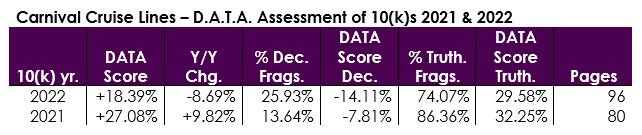
What follows is a summary of Deception And Truth Analysis’ assessment of Carnival Cruise Lines’ 2021 and 2022 10(k) annual reports:
Deception And Truth Analysis Assessment Summary
D.A.T.A.’s primary output is our DATA Score. It ranges between -100% and +100%, with any negative score indicative of a document’s aggregate level of deceptiveness, and any positive score indicative of a document’s aggregate level of truthfulness. DATA Scores at the time of this writing have a mean score of 6.02% and a standard deviation of 13.88%.
Carnival Cruise Lines’ 10(k)s both score in the aggregate as truthful with the 2021 document being 1.5 standard deviations above the mean and the 2022 document being 0.9 standard deviations above the mean. In other words, the company is above average truthful. That said, CCL’s truthfulness declined by 8.69 percentage points relative to 2021 levels.
Continuing on, the amount of deception sections in the CCL 10(k) has nearly doubled from 13.64% in 2021 to 25.93% in 2022. Additionally, the average DATA Score of CCL’s deceptive sections has worsened by almost 100% from -7.81% in 2021 to -14.11%.
Looking at the truthful fragments also reveals an interesting story. Truthful fragments have of course fallen in 2022 relative to 2021 since the number of deceptive fragments increased year on year. Interestingly, while the percentage of the document that is truthful has fallen, when the company is being truthful the average DATA Score is roughly the same in 2022 as in 2021.
We note with great interest that the number of pages of the 10(k) has increased by sixteen pages year on year. In other words, CCL is disclosing more information, but it is deceiving more, too. A natural question to ask is: what has changed year on year such that CCL is deceiving more, and when they are deceiving it is more deceptive? D.A.T.A.’s REDline product is a perfect solution to dig deeper because we show the running narrative of deceptiveness and truthfulness through documents.
DATAREDline Assessment of Carnival Cruise Lines
Here is a screenshot of CCL’s 2021 10(k):
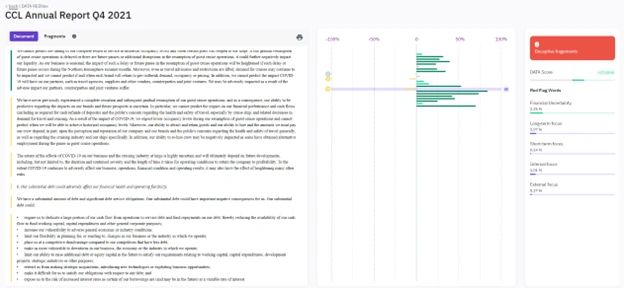
For convenience we have selected CCL’s most deceptive fragment. You can verify that by looking at the REDline graph in the center of the image (i.e. the part of the picture with the green, yellow, and orange bars). On the left hand side of the picture is the language associated with their most deceptive fragment.
As you can see from the above excerpt, the company is discussing its risk factors. Specifically, this fragment, assessed by D.A.T.A. as their most deceptive concerns the company’s response to COVID-19, as well as risks to the company because of its capital structure, and its maintenance covenants.
By contrast, here is a screenshot of CCL’s 2022 10(k):
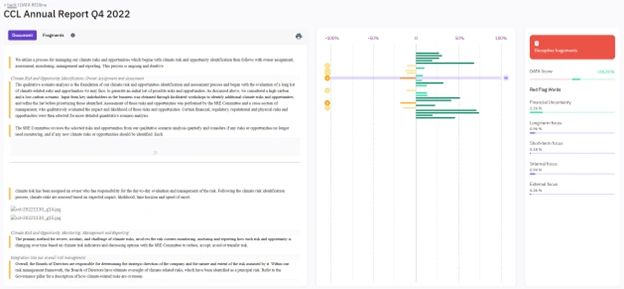
One thing that immediately jumps out is the higher number of deceptive fragments in 2022 as compared with 2021. Those are the yellow, orange, and green bars shown to the right of the 10-K. There is one repeat fragment from last year’s 10(k). Namely, CCL’s capital structure being too debt heavy.
For convenience we have highlighted the most deceptive fragment’s text in the picture above, which appears on the left side of the image. Once again the most deceptive fragment falls in the midst of CCL’s risk factors disclosures. Interestingly, though, the risk factor that is at the center of D.A.T.A.’s assessment is all about their climate risks and disclosures. This is a significant change from the year prior.
Here’s the thing, though, all of those additional deceptive fragments (as indicated by the yellow and orange bars) year over year are new to their 10(k) reporting, and they have to do with CCL’s disclosures in its 10(k) of its: Sustainability efforts; reporting of its carbon footprint; governance structure; narrative around the US’ Clean Water Act; and risk from failing to achieve its sustainability related goals. Let’s give CCL credit for the additional climate-related disclosures.
But, it is a reasonable conclusion then that CCL is disclosing more information, but it is not being transparent since their disclosures have doubled the company’s level of deceptiveness in its 10(k). This is a lesson that those in finance and investing are well-acquainted with: disclosure and transparency are not the same thing.
An analyst assessing the ESG efforts of CCL can reasonably conclude that they are being deceptive about their sustainability initiatives. This should also then lead to analysts questioning the ‘environment’ portion of the company’s ESG. But it should also lead to a more important realization: the company’s ‘governance’ portion of ESG has gotten worse.
What Should an Investor Do with DATA’s CCL Assessment?
In short, based on the above analysis, an investor should call CCL’s investor relations department and ask additional and deeper questions about the company’s governance structure since its disclosure around their policies was flagged by D.A.T.A. For example, what are the checks and balances that ensure good governance? What power, resources, and authority does the board have in examining and enforcing CCL’s governance? Another good question would be how does the board and how do auditors check the company’s governance quality?
But wait, there’s more! Beyond asking CCL about its governance, most of its deceptive fragments had to do with their sustainability disclosures. That they are being deceptive about this warrants additional questions. Immediate questions that could be asked would be about how the company measures progress on its sustainability goals? How has measurement changed over time; including have the data sources or providers changed? Are the number of factors tracked static, or have they changed? Another good question might be how much of managements’ time is spent on managing sustainability issues? Does management compensation include incentives to improve sustainability? Is the company’s sustainability progress audited independently?
Conclusion
Governance is the least evolved, but most important of the ESG factors. After all, if governance is poor can you really trust a company’s disclosures about its environmental and social impacts? A critical way to measure governance is to have a scientific and objective method for assessing a company’s deceptiveness and truthfulness, such as that provided by Deception And Truth Analysis. When assessing Carnival Cruise Lines, D.A.T.A. finds that it is deceptive about its Sustainability standards, calling into question its governance, as well as its environmental impact management.

0 Comments