


At Deception And Truth Analysis (D.A.T.A.) we have discovered an interesting anomaly in our dataset that we think investors need to know about. Namely, that companies’ level of deceptiveness and truthfulness in quarterly regulatory filings fluctuates dramatically depending on the quarter. So, which regulatory filings are most truthful as assessed by DATA Scores?[i]
The Most Truthful Quarter is…
In short, the answer is that for 2008 thru 2021 for the companies in the S&P 500 their 10(k)s are assessed by D.A.T.A. as being the most truthful. In fact, not only do 10(k)s score, on average as the most truthful quarterly regulatory filing with an average DATA Score of 10.03%, but an overwhelming majority of the S&P 500’s components’ DATA Scores are truthful, with an average 82.03% of companies having truthful reports. Additionally, there has not been a period 2008 thru 2021 in which the average DATA Score in the fourth quarter has been deceptive.
Here is the breakdown by quarter for all periods…
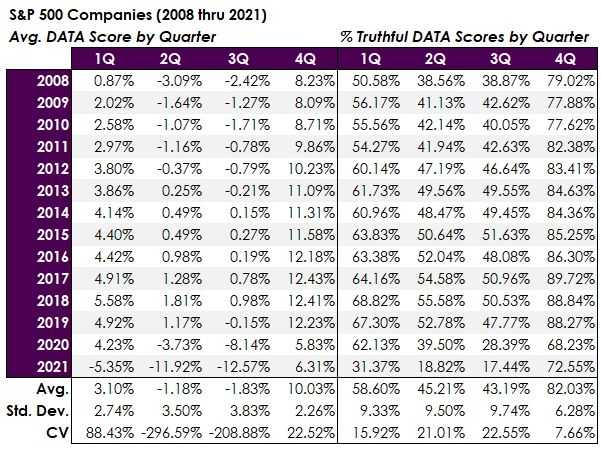
As you can see from the table above, the fourth quarter 10(k)s for the S&P 500 2008 thru 2021 are joined by first quarter 10(q)s as being, in the aggregate truthful, while the second and third quarter 10(q)s score as deceptive in the aggregate. Why might this be?
The Anomaly is Only Coincident with the Seasons
While it may be tempting to see seasonality in time series data, here the pattern has nothing to do with the trajectory of the Earth around the Sun and the affect on agriculture and human behavior. Instead, the coincidence with the seasons is that most companies spend the greatest amount of time in preparing their fourth quarter 10(k)s, rather than the less important quarterly, 10(q)s. Additionally, auditors and regulators also scrutinize the annual report much more thoroughly than the quarterly reports. At least, that is our theory as to why we see this anomaly in the data.
Professor Supports Our Point of View
Because the pattern we have uncovered is so consistent we spoke with a professor of auditing at Tilburg University in the Netherlands who has confirmed that in his experience as both an auditor, as well as an advisor on auditing issues, that he has seen a similar pattern, but measured by accuracy of accounts, rather than by deceptiveness. Importantly, D.A.T.A. does not use numbers in developing its DATA Scores. Instead we assess the level of deceptiveness or truthfulness in documents by examining a company’s language using NLP to look for more than 30 known behavioral differences between deceivers and truth tellers. In other words, our auditing contact’s anecdote is a statement about the preparation of quantitative data, whereas ours is a statement about the qualitative data. But both statements support one another.
First Quarter, Que Pasa?
So, what explains what is happening in the first quarter 10(q)s; why are they truthful, in the aggregate as measured by DATA Scores? Again, our theory is that management likely spends a little bit more time on the first quarter’s reports because it is a way of them confirming their forecasts for the year. Consequently, they likely engage their internal auditors to a greater extent in the first quarter than the dog days of, say, the third quarter. Our auditing contact agreed with our assessment, incidentally.
What COVID?
Last, we wanted to point out that from the fourth quarter of 2013 thru the second quarter of 2019 marked a remarkable run of 15 quarters for the S&P 500’s companies being assessed as truthful in the aggregate. But for the small blip in the third quarter of 2019 with an aggregate DATA Score of -0.15% the run would have been 18 quarters long. So what upset the trend in the second quarter of 2020? Unless you have been sleeping in a cave then you likely know that is the quarter in which COVID-19 was in full bloom.
Conclusion
If you are an investor relying on 10(k)s and (q)s in your due-diligence work then you should know that companies score as more deceptive in the second quarter, and especially in the third quarter. These documents likely then provide a different kind of window into the performance of your portfolio companies than either the annual 10(k) or first quarter 10(q).
[i]DATA Score stands for Deception And Truth Analysis Score. Our scores range between -100% and +100% with any negative score indicating deceptiveness in the aggregate, and any positive score indicating truthfulness in the aggregate. DATA Scores are roughly normally distributed with a mean of 6.02% and a standard deviation of 13.88%.

0 Comments