

Deception And Truth Analysis (DATA) is proud to announce that at long last we have earnings call transcripts, as well as other company transcripts on our DATAbase Platform thanks to our partnership with S&P Global. What follows is a Case Study analysis of ServiceNow (ticker: NOW) where we demonstrate the power of combining the information found in the company’s earnings call transcripts and its regulatory filings together.
In short, the crucial information – that the company’s gross margins were under significant pressure – and knowledge of which would have saved investors around 20% is contained in its regulatory filings, not its earnings call transcripts. But that said, the ultimate and subtle admission of gross margin compression leading to deceptive behavior on the part of management is finally revealed in an earnings call. In other words, investors needed a tool like DATA and our ability to rapidly surface actionable investment insights and then summarize them in easy-to-digest tools.
One of the initial assumptions many of our Clients make about DATA is that we only are useful in uncovering the worst kind of malfeasance: fraud. But one of the reasons we love this Case Study is that ServiceNow’s story is not one of DATA flagging a fraudulent company, far from it. Instead, we are highlighting our power to provide everyday, mundane sorts of insights that reside in abundance on our platform and that our Clients rely on us to unlock on a daily basis and that can add crucial basis points to your returns.
Case Study: ServiceNow: Executive Summary
In ServiceNow’s situation the company found its growth flagging and brought in a new CEO in late 2019. But his efforts to help the company compete seemed to flag as indicated by its eroding gross profit margins which is a fact revealed by DATA’s assessment of NOW’s regulatory filings and starting early in 2021, months before this issue was acknowledged on its earnings calls.
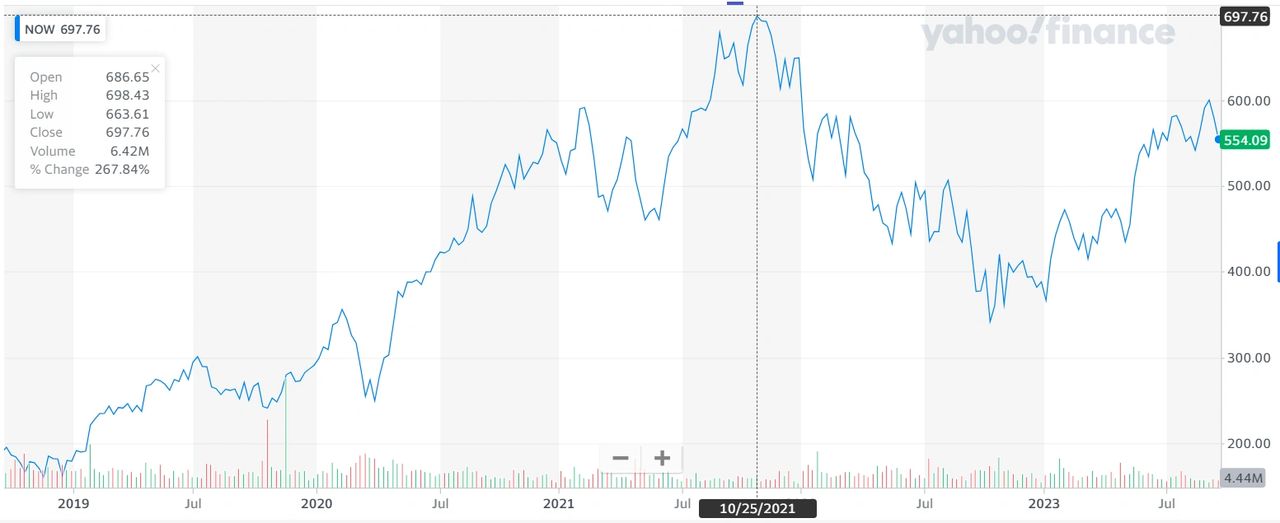
As 2021 progressed the company’s most high risk fragment in its regulatory filings continued to be about its gross margins. Eventually this led to an accounting change by the company regarding its Useful Lives and that was finally revealed in October 2021 in an earnings call. Shortly after this earnings call the company hit its all-time high in stock price. Subsequently, the stock price has never recovered and has been dead money since.
The above scenario is not fraudulent, but it is deceptive, and is all too typical at companies. They face top-line and bottom-line growth pressures. They try their best to accomplish this. When investor expectations become difficult to deliver they then pull what levers they can. In ServiceNow’s case it appears that they cut prices on their products to grow the top-line. This, of course, hurt their gross margins. When this did not work, in order to maintain expectations they appear to have pulled the “accounting policy discretion” card.
But this above sequence mirrors what we find at DATA all the time. Namely, looking at the financial results is a lagging indicator. Numbers are driven by management’s choices. In turn, these choices are driven by their behaviors. If you have a way of measuring managements behaviors, such as evaluating the amount of their deceptive and truthful language you get a sneak preview of what is ultimately baked into their numbers.
Service Now: Chronology of a Decline
1. October 2019: ServiceNow announced it hired a new CEO, Bill McDermott. Ostensibly this was to improve the competitiveness of the company in the marketplace.
2. 15 November 2019: ServiceNow released an 8(k) – also featured in our DATAbase product – in which it discussed the Board’s changes to the management structure of the company. In addition to discussing the hiring of McDermott, the company disclosed the hiring of a new CFO, Gina Mastantuono. This 8(k) was assessed by us as having a DATA Score* of +100%, or having very low risk. This is not surprising given that most of what is conveyed in the 8(k) are the facts of the management transition.
3. 4 December 2019: Just after Bill McDermott onboarded as CEO, Lara Caimi, Chief Customer Officer of ServiceNow spoke at the Wells Fargo Tech Summit, a transcript that is on our DATAbase platform. An excerpt of her overall remarks, and about her feelings surrounding the hiring of McDermott, were assessed with a DATA Score of -11.123%, or -66.82%-ile deceptive. Here is what Ms. Caimi said and that we assess as deceptive:
“Yes. Obviously, it’s been a big month. Everyone, I think, was a little bit shocked in the beginning, but it’s been a very smooth transition. And I think on balance, everyone’s really excited about Bill’s experience, his expertise and what he can bring. And so what was beautiful was to watch the transition the week of, the way that — seeing 2 CEOs of their caliber kind of onstage together, whether it was in the press, with investors and then in an all hands with all of our employees and how quickly people transitioned from being sad about John and shocked maybe, to real excitement about Bill. I think he has built and seen where we want to go as a company. And so his expertise in really scaling a software business, drive the evolving go to market to the next level is what we need. And everyone is super excited about what he brings to the table. So he’s indicated that he wants to run with the existing management team, maintain our strategy. Of course, he’ll evolve it and tweak it as he gets on board, but everyone’s super excited about him.”
Thus, Clients of DATA are able to see that there is likely some unease about the hiring of McDermott even two months on from his hiring. By contrast, when she talks about revenue opportunities later at the event at Wells Fargo, her remarks have a DATA Score of +100%.
4. 29 January 2020: ServiceNow hosts its Q4 2019 earnings call in which McDermott lays out his new approach to leading ServiceNow. These comments in its transcript were assessed by us in three separate fragments. DATA Scores were +46.848%, +63.256%, and +54.950%. Each of these statements is at least in the 91st %-ile of truthful, or low risk. In other words, McDermott absolutely believes what he is saying.
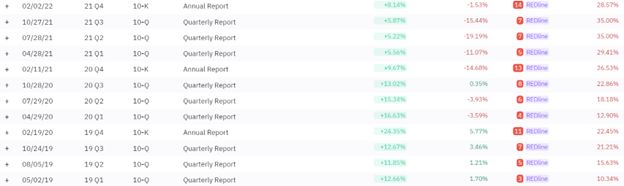
5. 11 February 2021: ServiceNow releases its 10(k). Its aggregate DATA Score is +9.67%, or in the 50.09th %-ile of truthful, or low risk. The document has a year-over-year change of -14.68%. In other words, the company has become more deceptive in the last year.
This is shown in the picture below on row 5, column 6. Also, you can see below the trajectory of Year-over-Year DATA Score changes in its regulatory filings is that from this document forward for a year it continues to register DATA Score declines starting with this particular annual 10(k) report. Specifically, their Year over Year DATA Score changes were -14.68% (4Q 2020), -11.07% (Q1 2021), -19.19% (Q2 2021), and -15.44% (Q3 2021).
Last, the numbers in the red boxes to the right of the year-over-year changes show the number of high risk fragments in ServiceNow’s documents. One column over from that, the last column on the right, the % of the document’s fragments assessed by us as high risk is shown. Note, the increase in the % of high risk fragments at the same time the aggregate DATA Score is falling year-over-year. This is a clear indication that investors need to dig deeper as the company’s language is shifting from the low risk side of the ledger to high risk.
ServiceNow’s most high risk fragment is Fragment 29, with a DATA Score of -39.884%, or -97.947th %-ile, indicating very high risk. The language contained in this fragment, their most deceptive, features as very high risk this statement:
“Cost of subscription revenues increased by $181 million for the year ended December 31, 2020, compared to the prior year, primarily due to increased headcount and increased costs to support the growth of our subscription offerings. Personnel-related costs including stock-based compensation and overhead expenses increased by $80 million and depreciation expense related to data center hardware and software and maintenance costs to support the expansion of our data center capacity increased by $88 million as compared to the prior year. In addition, amortization of intangibles increased by $12 million as a result of acquisitions.”
This fragment directly addresses declines in the company’s gross margins. Given that it is flagged by DATA as very high risk in a document whose Year-over-Year DATA Score shows a significant decline in the company’s truthfulness deserves additional scrutiny. Investors would be wise to discuss the company’s gross margins with its investor relations team. Further, if they were modeling ServiceNow’s future performance they probably would want to play around with their assumptions for the company’s gross margins. At the very least, this should be something that is watched by thoughtful investors.
NOW’s stock price at this moment is $594.47 per share.
6. 27 April 2021: NOW hosts its first quarter 2021 earnings call. Its DATA Score is 54.07%, or 96.25th %-ile, or very low risk, with only one fragment scoring on the high risk side of the ledger, Fragment #2, with a DATA Score of -4.918%, or Moderately High Risk. Discussed in this Fragment is high demand; ServiceNow’s teams’ innovations; new products; and a regional breakdown of sales performance.
Gross margins, and margins in general, are mentioned in Fragment 4 and assessed with a DATA Score of 5.653%, or on the truthful side of the ledger as Moderately Low Risk:
“We continue to expect subscription gross margins of 85% and operating margin of 23.5%. Finally, we expect recapture margin of 30% and 202 million diluted weighted outstanding shares for the year.”
Noteworthy on this call is that management does not dwell on gross margins, nor does the investment community on this earnings call.
NOW’s stock price is $562.63 per share on this date.
7. 28 April 2021: NOW’s first quarter 10(q) issued. Its most deceptive fragment is #13, assessed with a DATA Score of -32.965%, or -95.37th %-ile, indicating very high risk. This fragment discusses, you guessed it, the company’s gross margins and their expectations for gross margins going forward. Note how much more high risk the DATA Score in the regulatory filing around their complete gross margin picture is, as compared with the disclosure in the earnings call the day prior.
NOW’s stock price is $557.24 on this date.
8. 27 July 2021: ServiceNow hosts its second quarter earnings call. The overall transcript is assessed with a DATA Score of +45.21%, or 90.42nd %-ile, or very low risk. Margins were very specifically discussed in Fragment 4 of the document when Gregg Moskowitz of Mizuho Securities asked the following question:
“I think your subscription gross margins were a bit lower than they’ve been in a while. Is there anything that you would call out here?”
To which Gina Mastantuono responded:
“Yes. The margins we talked about there, we’re keeping them flat for our guide. But they are impacted versus the prior year a bit. And we talked about this earlier in the year. We’re making increased investments in our data centers and customer support to serve customers impacted by the new data residency regulations as well as serving our customers who require additional security measures such as IL5 for our Fed customers. So those are big-ticket items that are impacting our margin. That was included in our original guide for the year, and we are achieving exactly what we set out to do on both those fronts.”
The fragment, of which just a small portion is excerpted above, was assessed by us with an overall DATA Score of 100%, or very low risk. But the excerpted paragraph from that same fragment quoted above from Ms. Mastantuono is actually the highest risk portion of that fragment.
NOW’s stock price is $582.29 on this date.
9. 28 July 2021: NOW releases its second quarter 10(q) as per usual, the day after its earnings call. By contrast with the gross margin story told above in ServiceNow’s earnings call for its second quarter is the one contained in its regulatory filing. First, their second quarter 10(q)’s aggregate DATA Score was 5.22% vs. its earnings transcript DATA Score of +45.21%. In other words, the 10(q) is assessed as having more risk than the earnings call. Furthermore, this 10(q) showed a Year-over-Year DATA Score change of -19.19%. In fact, this marks the third quarter in a row that a regulatory filing from the company shows a double-digit decline in its truthfulness.
In this 10(q) what do you suppose is their most deceptive fragment (see below)?
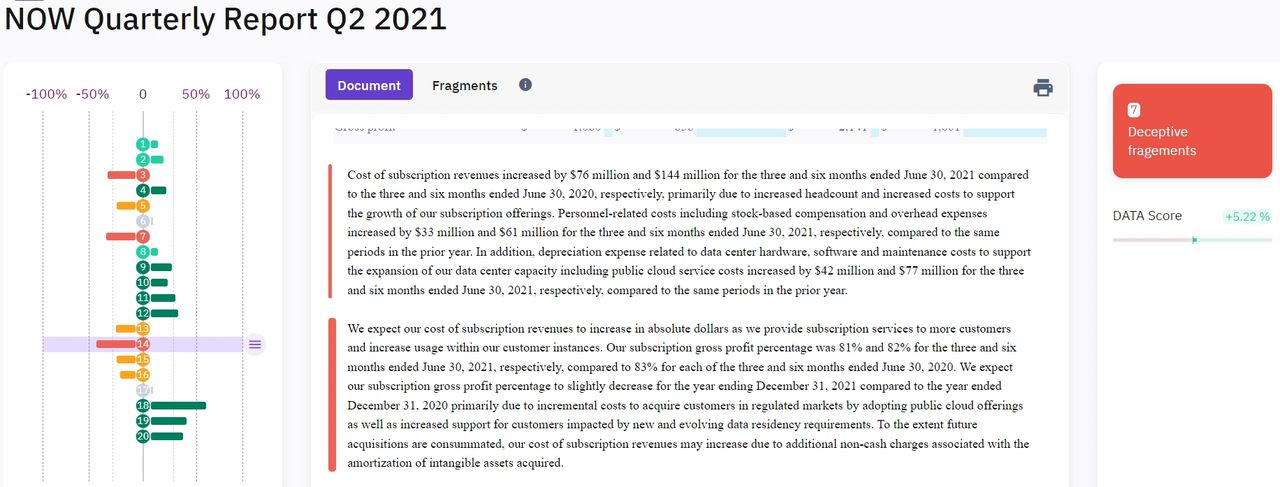
It is Fragment 14, unequivocally that stands out because it is assessed with a DATA Score of -42.32%, or -98.49th %-ile deceptive, and very high risk. This section features the following two paragraphs from the company regarding, you guessed it, their gross margins:
“Cost of subscription revenues increased by $76 million and $144 million for the three and six months ended June 30, 2021 compared to the three and six months ended June 30, 2020, respectively, primarily due to increased headcount and increased costs to support the growth of our subscription offerings. Personnel-related costs including stock-based compensation and overhead expenses increased by $33 million and $61 million for the three and six months ended June 30, 2021, respectively, compared to the same periods in the prior year. In addition, depreciation expense related to data center hardware, software and maintenance costs to support the expansion of our data center capacity including public cloud service costs increased by $42 million and $77 million for the three and six months ended June 30, 2021, respectively, compared to the same periods in the prior year.
[The above paragraph is a portion of the company’s most risky section, but is less deceptive than the one immediately below which discusses the company’s expectations for gross profit margins going forward.]
“We expect our cost of subscription revenues to increase in absolute dollars as we provide subscription services to more customers and increase usage within our customer instances. Our subscription gross profit percentage was 81% and 82% for the three and six months ended June 30, 2021, respectively, compared to 83% for each of the three and six months ended June 30, 2020. We expect our subscription gross profit percentage to slightly decrease for the year ending December 31, 2021 compared to the year ended December 31, 2020 primarily due to incremental costs to acquire customers in regulated markets by adopting public cloud offerings as well as increased support for customers impacted by new and evolving data residency requirements. To the extent future acquisitions are consummated, our cost of subscription revenues may increase due to additional non-cash charges associated with the amortization of intangible assets acquired.”
Let’s review what DATA has revealed so far:
- DATA is able to demonstrate that for three quarters in a row there is a double-digit decline in the company’s truthfulness.
- In these filings that show increasing amounts of high risk behaviors, their most deceptive, or high risk, sections for three quarters in a row has to do with their cost of subscription revenues, as well as their expectations for gross margins going forward.
That this should be a concern for investors is unequivocal, because as you can see in the above image, it shows that Fragment 14 is assessed as having the most risk in the document and the language flagged as very high risk is also shown and quoted above.our assessment of NOW’s 10(q), as well as the associated language with the section.
Stock price on 28 July 2021: $582.29
10. 26 October 2021: ServiceNow hosts its third quarter earnings call. This transcript is assessed with a DATA Score of 34.03%, or 74.67th %-ile, or low risk. There is no mention of actual margin compression on this call. Instead in section 5 of the transcript Gina Mastantuono, CFO, says regarding margins:
“That being said, at our Financial Analyst Day in May, I talked about committing to 26.5% margin by 2024. We absolutely remain committed to that and on that trajectory. But I don’t think that, that increase is going to be linear, right? As we think about offices reopening and travel becoming more consistent and in-person events happening more, we definitely don’t believe that it’s going to be a linear path to 26.5%. I’m not actually in a position at this point to guide to 2022, but we are 100% committed to, over that 3-year period, getting to 26.5% because we absolutely believe that we’ll have savings that we’ll be able to take from these learnings and efficiencies from the pandemic and redeploy them on growth opportunities that we see absolutely in front of us today.”
Stock price on 26 October 2021: $676.71, up 16.22% from 28 July 2021.
11. 27 October 2021: NOW releases its third quarter 10(q) and it is assessed with a DATA Score of 4.08%, or -20.46th %-ile, or moderately high risk. Compare this with the DATA Score for its earnings call transcript immediately above. Again, the company’s most high risk paragraph, #14, is assessed with a DATA Score of -41.517%, or -98.33rd %-ile, or very high risk. The section again discusses its cost of subscription revenues and the company’s expectations for them. See excerpt, below:
“Cost of subscription revenues increased by $75 million and $219 million for the three and nine months ended September 30, 2021 compared to the three and nine months ended September 30, 2020, respectively, primarily due to increased headcount and increased costs to support the growth of our subscription offerings. Personnel-related costs including stock-based compensation and overhead expenses increased by $31 million and $92 million for the three and nine months ended September 30, 2021, respectively, compared to the same periods in the prior year. In addition, depreciation expense related to data center hardware, software and maintenance costs to support the expansion of our data center capacity including public cloud service costs increased by $34 million and $111 million and amortization of intangible assets increased by $8 million and $15 million for the three and nine months ended September 30, 2021, respectively, compared to the same periods in the prior year.
“We expect our cost of subscription revenues to increase in absolute dollars as we provide subscription services to more customers and increase usage within our customer instances. Our subscription gross profit percentage was 81% and 82% for the three and nine months ended September 30, 2021, respectively, compared to 83% for each of the three and nine months ended September 30, 2020. We expect our subscription gross profit percentage to slightly decrease for the year ending December 31, 2021 compared to the year ended December 31, 2020 primarily due to incremental costs to acquire customers in regulated markets by adopting public cloud offerings as well as increased support for customers impacted by new and evolving data residency requirements. To the extent future acquisitions are consummated, our cost of subscription revenues may increase due to additional non-cash charges associated with the amortization of intangible assets acquired.”
ServiceNow’s stock price on this day is $664.76.
12. 4 November 2021: Stock price hits an all-time high of $701.73, up 20.51% from 28 July 2021.
13. 25 January 2022: NOW’s annual earnings call is held. The transcript of this event was assessed with a DATA Score of +10.62%, or 3.73rd %-ile, or moderately low risk; whereas their 10(k) of 2/2/2023 had a DATA Score of 8.14%, or -5.52nd %-ile, or moderately high risk. Note that the DATA Score for the earnings calls gradually fell into line with the company’s regulatory filings. Interesting, but not necessarily significant. In Fragment 3, assessed with a DATA Score of 40.196%, or 84.75th %-ile, or low risk, the company states something incredible and very important to our overall Case Study because they finally acknowledge publicly that their gross margin pressure has led to an accounting change to compensate:
“I would also note that in January, we completed an assessment of the useful life of our data center equipment and determined that we could extend their estimated life from 3 to 4 years [emphasis: ours]. As a result, we expect a reduction in depreciation expense, which will contribute approximately 100 basis points to gross margin in 2022, trending down to just 50 basis points in 2024.”
This is an accounting change done to increase gross margin, and was absolutely telegraphed to the Clients of Deception And Truth Analysis by our highlighting of ServiceNow’s gross margins having been under pressure for all of 2021.
Why did this change need to happen? Later in Fragment 7 of this earnings call, assessed by us with a DATA Score of -13.328%, or -71.71st %-ile, or high risk, Gina Mastantuono, CFO, states:
“And then, Keith, on your question with respect to labor inflation rates. Enterprise software’s talent has been in high demand for some time now. So competitive compensation has been on the rise, and it’s not new for us. We continue to monitor it. We definitely anticipate some continued pressure in the coming quarters, but we remain very committed to our margin guidance that we’ve given you for 2022 and beyond.”
Fragment 8 of the ECT features a great question from Michael Turits of KeyBanc Capital Markets, in which he asks about that extension of useful lives:
“Great. And then, Gina, just some clarifications on the extension of the useful life. So you got essentially to flattish op margins but down a bit, like 70 bps on free cash flow. So just making sure that I understand it, and then obviously, you get that benefit to EBIT margins, but that flows through, and we see it on free cash flow because this is just a noncash, and you’re actually including expenses. So I want to make sure those mechanics are right. And then also, do you get in year 2 of this — do you get that tailwind to EBIT and accrual? Does that flip around to a headwind on EBIT margins and gross margins?”
Gina responds:
“Great question, Michael. So you’re absolutely right, the benefit that you’re seeing this year hit EBIT and operating margins, but not free cash flow, right, because it’s just a change in depreciation, which is a noncash, right? So that’s the reason why you’re seeing the benefit in operating income, but not as free cash flow. What you are seeing is free cash flow is the increased cost that I’ve been talking about as the COVID savings start to fade in ’22 as we come back in person for digital events and in-person events in [indiscernible]. With respect to the longer tail of this change in depreciation, it definitely tapers off and get smaller, right? So it’s a 100 basis point benefit this year by 2024. It goes down to just 50 points, right? So — and that’s only on the EBIT margins, not on free cash flow.”
By contrast, in the company’s 10(k), released the very next day, in Fragment 30, scoring -41.988%, or -98.43rd %-ile, or very high risk, it has to do with that perennial ServiceNow issue:
“Cost of subscription revenues increased by $291 million for the year ended December 31, 2021, compared to the prior year, primarily due to increased headcount and increased costs to support the growth of our subscription offerings including costs to support customers in regulated markets. Personnel-related costs including stock-based compensation and overhead expenses increased by $123 million as compared to prior year. Depreciation expense related to data center hardware and software and maintenance costs to support the expansion of our data center capacity including public cloud service costs increased by $141 million and amortization of intangibles increased by $29 million as a result of acquisitions as compared to the prior year.”
Stock price on 27 January 2022: $528.69, down 24.66% from all-time high.
14. 22 September 2022: Stock price is $554.09, down 18.12% from its all-time high of almost two years earlier, and is down 4.84% from 28 July 2021. In other words, NOW has been dead money for two years.
Conclusion
In case this is not clear, the crucial information in assessing ServiceNow, that its gross margins were under pressure, as represented by its very high risk language around them, was contained within its regulatory filings for most of 2021. By contrast, the company did not disclose its issues around gross margins on an earnings call until late October 2021. When ServiceNow did disclose its issue, it floated this into its earnings call ever so subtly by disclosing a change of the useful lives of its datacenters from 3 years to 4 years. This is the sort of mundane, but impactful language that DATA highlights every single day for its Clients. In other words we provide a daily assist to our Clients and not just with the rare, but colossal fraud.
NOW hit an all-time high just after its October 2021 call, but subsequently experienced a precipitous fall of over 20%, and its stock has been dead money for over two years. Deception And Truth Analysis provided rapid, actionable insights of the entirety of this picture to its Clients by using a combination of our innovative assessments on its regulatory filing assessments and transcripts.
* DATA Scores range between -100% and +100%, with any negative score being indicative of deceptiveness, or high risk; and any positive score being indicative of truthfulness, or low risk. DATA Scores are roughly normally distributed with, at the time of this Case Study, a mean of 9.62% and a standard deviation of 21.37%.

0 Comments