

Over the last several weeks we featured validation results from both CloudQuantand Solactive that demonstrate the power of Deception And Truth Analysis (DATA) Scores to improve investment returns for large cap investors. In this week’s article we focus on another key validation insight. Namely, that investment markets price DATA signals slowly. This is interesting for several reasons:
- DATA is measuring something that markets care about but are slow to price. This is demonstrated by the average return advantage monthly of 0.51%, quarterly of 1.46%, and annual of 6.39% (2008 thru 1Q 2023 for all).
- Gigantic investors have the opportunity to implement trades based on DATA signals.
As a reminder, the DATA algorithm has never seen a stock price. Nor do we train a model using machine learning. Instead, we have built a deception and truth detection algorithm based on the one hundred years of findings of deception science and its more than 8,000 papers. Our Natural Language Processing algorithm looks for more than 30 behavioral differences between deceivers and truthtellers. That DATA Scores are predictive of future securities prices means that markets do price what we are measuring even though our assessments are blind to stock price movements.
We would love to speak with you about how we can help your organization improve its results by better assessing the trustworthiness of the people whose words you rely on. Click here for a demo meeting.
Longer Lookback + Holding Periods = Better Returns
As you can see in the chart below from CloudQuant’s whitepaper that independently validated the importance of DATA Scores in improving returns both longer Lookback Periods and longer Holding Periods result in much greater Sharpe Ratios.
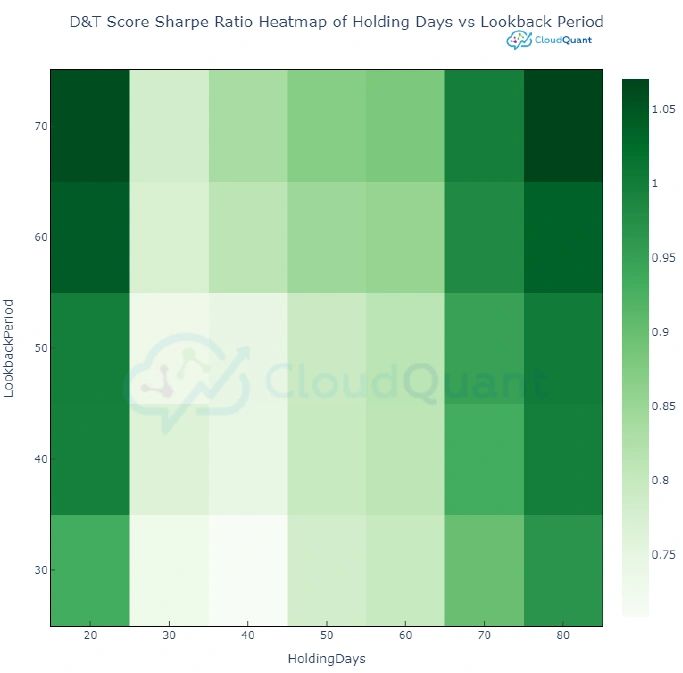
For the shortest time period shown above with a Lookback Period of 30 trading days and a Holding Period of 20 trading days (50 total trading days) a Sharpe Ratio of around 0.90 is achieved for the period 2008 thru the first quarter of 2023.
Stock markets are not open every day of the year which means that there are only 0.77 trading days per every calendar day, on average. Thus, 50 trading days is around 65 calendar days, or two months. CloudQuant’s work focused on DATA Scores rendered on companies’ annual 10K and quarterly 10Q regulatory filings.
So, on the short end of the time horizon, investors are pricing the informational content of DATA Scores only after two months after the publication of regulatory filings.
Meanwhile, using a Lookback Period of 70 trading days with a Holding Period of 80 trading days results in Sharpe Ratios in excess of 1.05 for the period 2008 thru the first quarter of 2023. Again, 150 trading days is equivalent to around 194 calendar days, or almost six months.
In other words, financial markets do value the informational content of DATA Scores, but they are exceedingly slow to price the information contained therein. Why might that be?
Why Do Markets Price DATA Score Informational Content Slowly?
Before providing a hypothesis about why financial markets price the informational content of DATA Scores slowly, another key piece of research needs to be shared with you. Long before Deception And Truth Analysis received independent validation from CloudQuant we conducted many of our own validation tests.
In one such test we evaluated whether DATA Scores rendered on company annual reports would successfully catch the 10 largest financial scandals of all time. Depending on how you measure the success of this validation work, we either caught 9 of the 10 largest financial scandals of all time, or 10 of 10. Regardless, one of the interesting insights from this work is that DATA Scores for these scandal companies were measured as deceptive in the aggregate for an average of 6.2 years (!) in advance of the scandal becoming public knowledge. Again, our conclusion is that markets are slow to price what our signals are measuring.
Our theory for why markets care about the information content of DATA Scores, but price is slowly, is that most investors spend all of their time evaluating the 1.7% of the information content of annual and quarterly reports that is quantitative. They do their financial statement analysis, their ratio analysis, and their valuation work on that very narrow slice of information.
Yet, the quantitative figures are simply the outcomes driven by managements’ choices. In turn, those choices are driven by their behaviors. If you have the capability of measuring behaviors then you have a means of not only earlier predicting outcomes, but a more accurate estimation of outcomes, too. Better yet, wouldn’t it be great if there were a technology that could quantify behavior based on an underlying science of behavior? That is exactly what Deception And Truth Analysis strives to do, and based on CloudQuant’s work, it is what we do.

0 Comments