
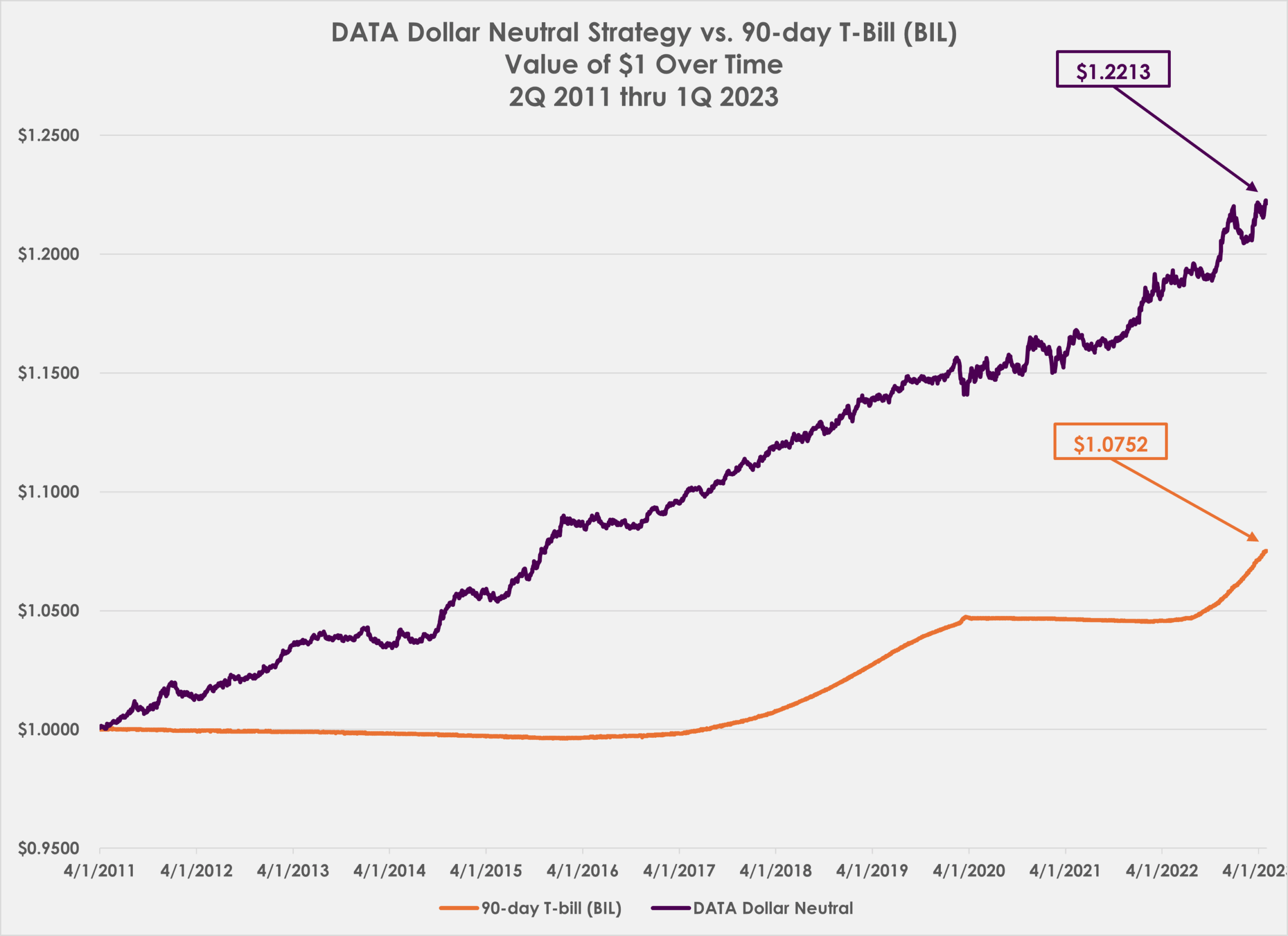

Back in January Cloud Quant[i] published a comprehensive whitepaper, Outperforming the Market with Measures of Deceptive and Truthful Language in Regulatory Filings, that independently validated that Deception And Truth Analysis Scores may be used to create many highly competitive investment strategies. These strategies outperform benchmarks and do so with greater consistency and lower volatility than benchmarks. Here is a summation of the ground covered so far:
- Independent Validation: DATA Handily Beats the S&P 500
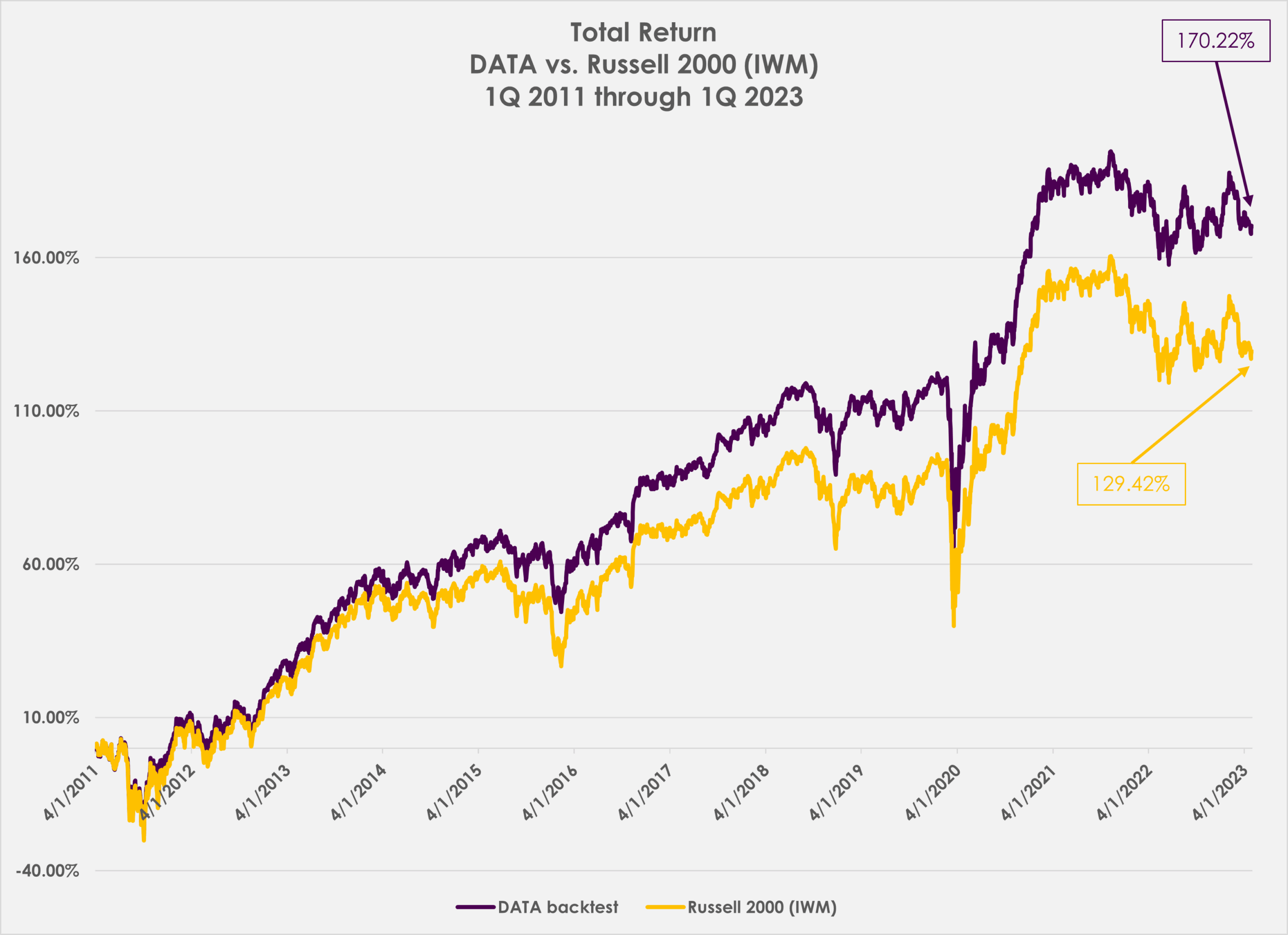
- Independent Validation: DATA Handily Beats the Russell 2000
In this week’s article we cover more a more esoteric strategy. Namely, using a combination of factors available on the DATA platform. The full details of the trading strategy are detailed in their whitepaper.[ii]
For those new to Deception And Truth Analysis, we have built an algorithm based on the findings of deception science which has over the last 100+ years and in 8,000 pieces of research identified behavioral differences between deceivers and truth tellers. We then use Natural Language Processing to look for more than 30 behavioral differences. Our algorithm is grounded in science, not machine learning and it has never seen a stock price. Instead, we measure human behavior and it appears to be the case that financial markets are slow to price managements’ behaviors, but that to do so is extremely beneficial to generating excess returns.
DATA Dollar Neutral Strategy: Major Results
The graph below shows the value of a $1.00 initial investment in CloudQuant’s dollar neutral trading strategy constructed using outputs on the DATA platform versus the 90-day Treasury Bill, as represented by the ETF equivalent ‘BIL.’
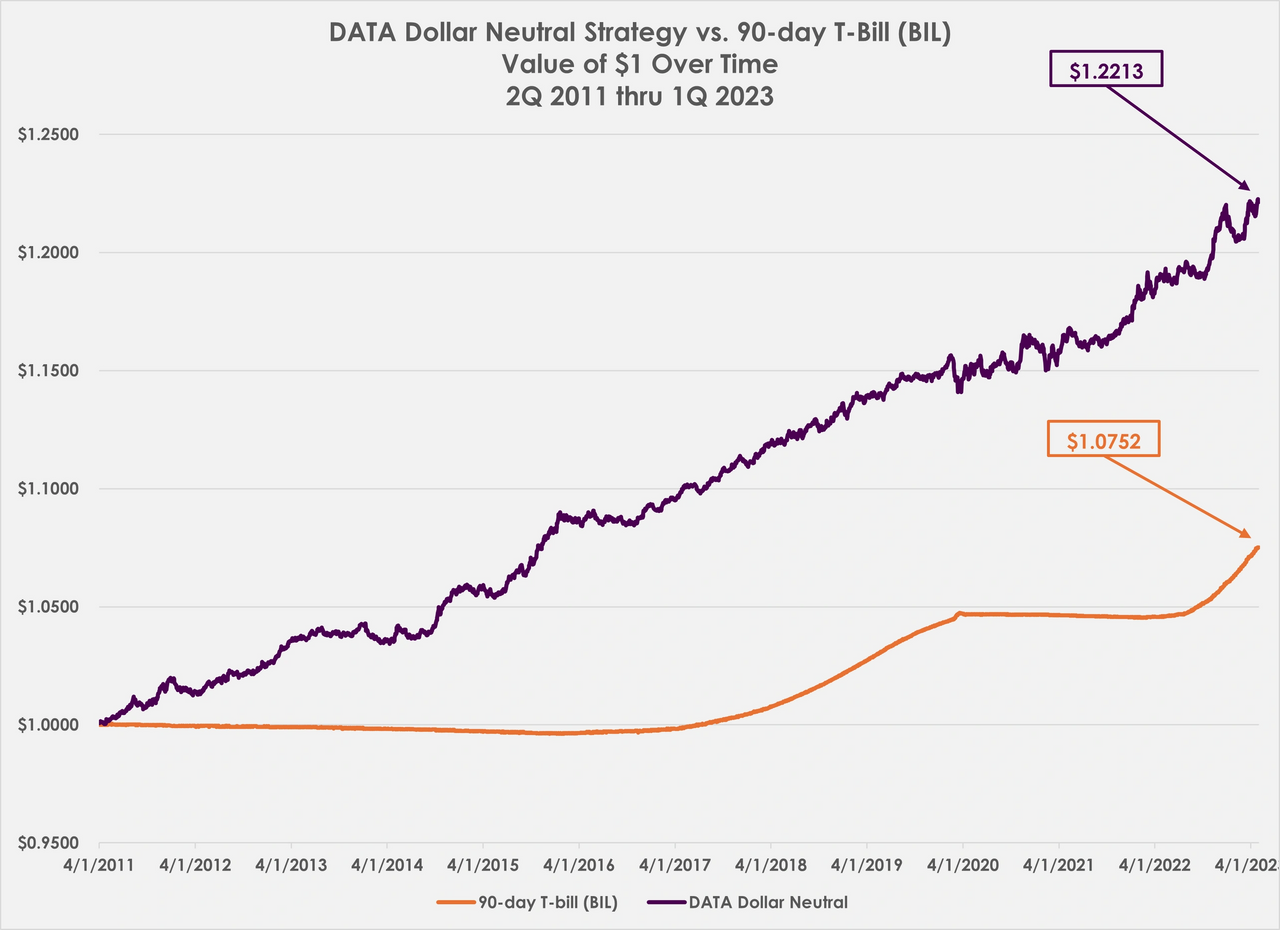
As you can see, the dollar neutral strategy using DATA Scores bests the 90-day Treasury Bill strategy over the period 2Q 2011 through 1Q 2023 $1.2213 versus $1.0752. This is an excess return at the end of the period of 14.61 percentage-points.
Further detail of the DATA dollar neutral strategy is shown below where the performance each year is shown, along with the annual excess return of the DATA dollar neutral strategy versus the 90-day Treasury Bill.
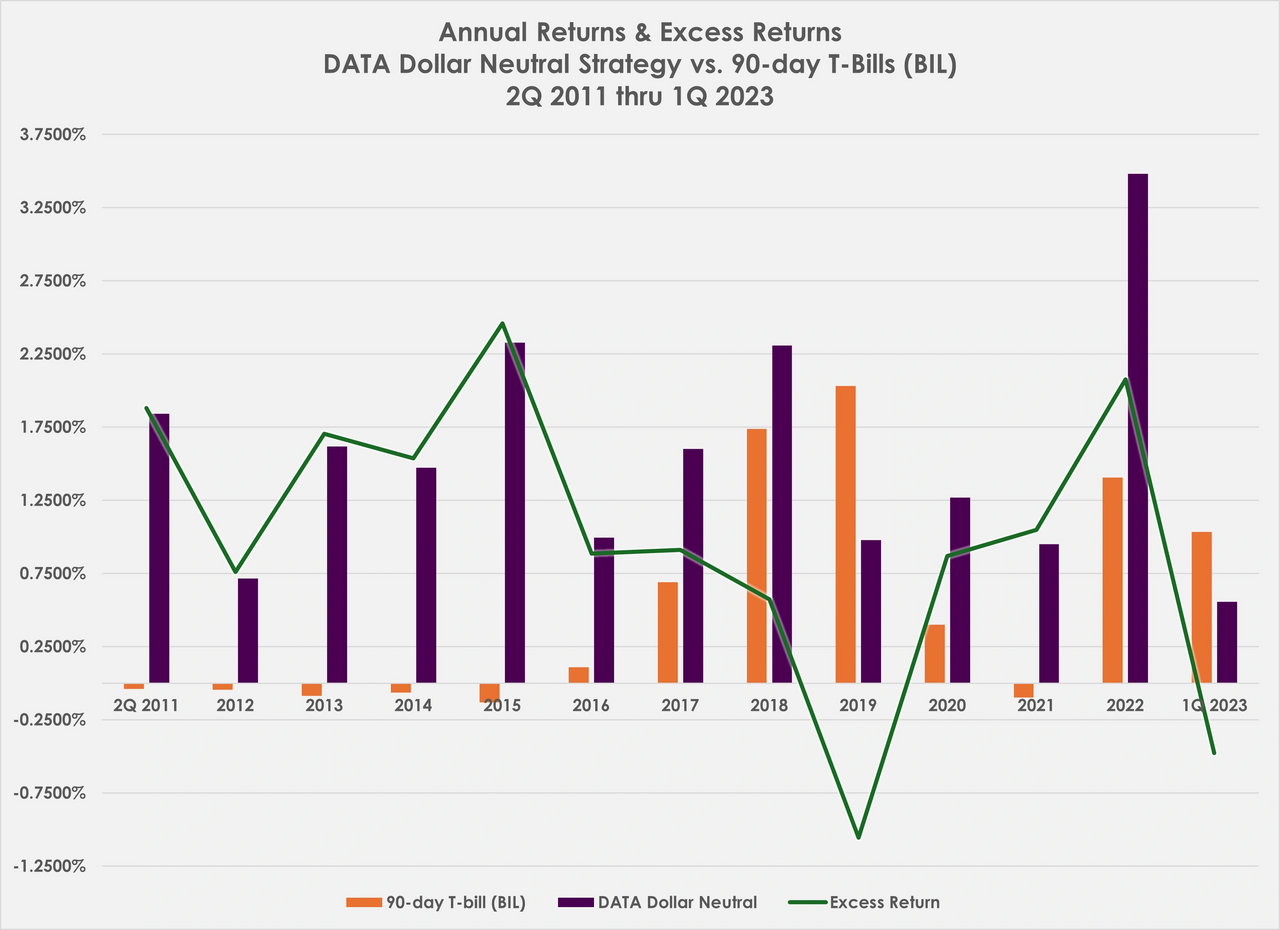
As you can see, above, the DATA dollar neutral strategy outperforms in all but one full-year (i.e. 2019) and one partial year (2023).
Below is a comparison of the DATA dollar neutral strategy versus the 90-day Treasury Bill, summaried below:
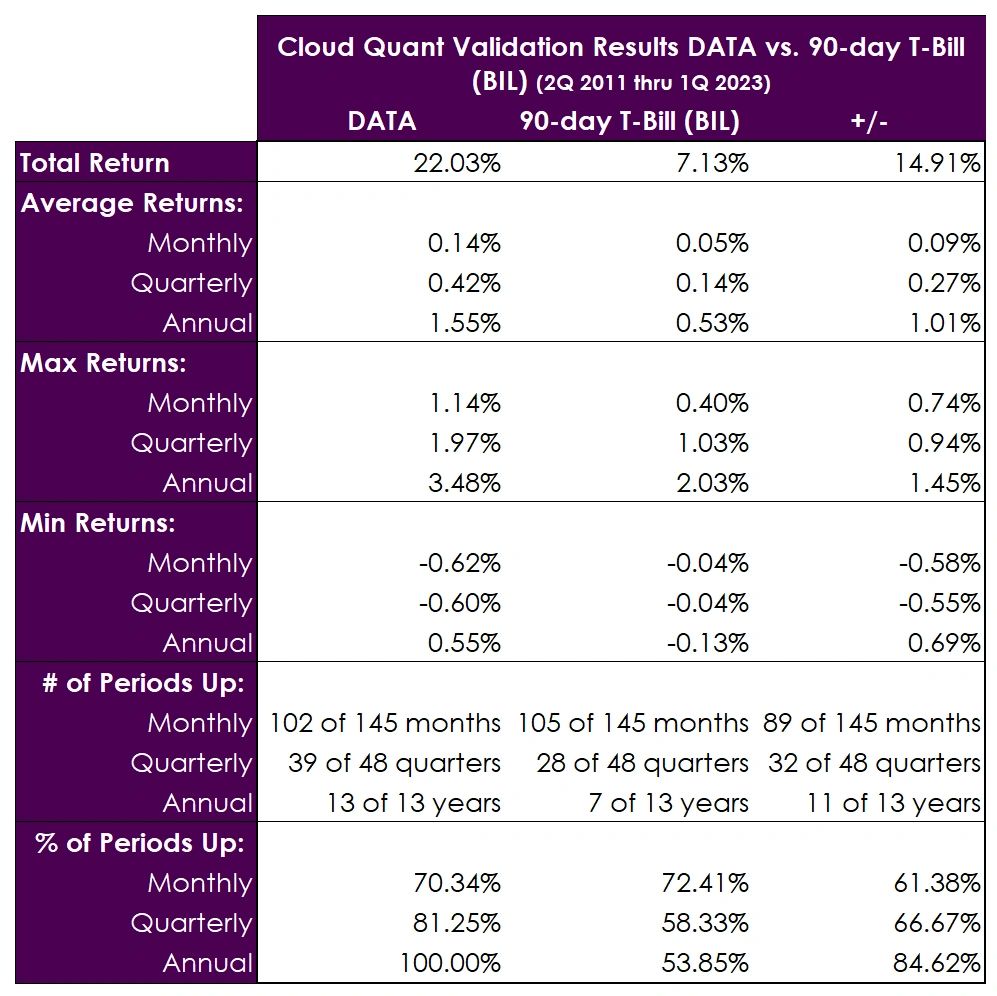
First, the DATA dollar neutral strategy’s average monthly, quarterly, and annual performance exceeds that of the 90-day Treasury Bill. These amounts are +0.09% per month, +0.27% per quarter, and +1.01% per year. Not shown in the chart above is the average daily return of the DATA dollar neutral strategy versus the 90-day Treasury Bill. Outperformance is present there, too: 0.007% versus 0.002%.
Second, the DATA dollar neutral strategy’s maximum return in a month of 1.14% versus the 90-day Treasury Bill’s maximum return in a month of 0.40%. This is an outperformance for the DATA dollar neutral strategy of +0.74%. Maximum returns for the DATA dollar neutral strategy are also larger than that of 90-day Treasury Bills for quarterly periods, +1.97% vs. +1.03%, and for yearly periods, +3.48% vs. +2.03%.
Third, in terms of Maximum Drawdown, the DATA dollar neutral strategy underperforms the 90-day Treasury Bill for the monthly and quarterly periods: -0.62% vs. -0.04%, and -0.60% vs. -0.04%. The maximum drawdown of the DATA dollar neutral strategy for yearly periods is +0.55% vs. -0.13%.
Next, the returns of the DATA dollar neutral strategy are more consistent than those for the 90-day Treasury Bill, which we can evaluate by looking at the proportion of months, quarters, and years of outperformance. Here the DATA dollar neutral strategy versus the 90-day Treasury Bill shows outperformance in: 89 of 145 months; 32 of 48 quarters; and 11 of 13 years.
Summary
If you were to invest in the DATA dollar neutral strategy versus the 90-day Treasury Bill then you would have outperformed on most days, as well as in most months, quarters, and years. Last, your returns would have been more consistent, meaning that your entry point and exit point are more likely to have generated outperformance.
[i] Another organization also independently validated the DATA platform with interesting large cap results and features in our article “Independent Validation: Twice Validated Large Cap Outperformance.” Available upon request.
[ii] For those interested in CloudQuant’s methodology we refer you to the whitepaper, pages 23-29.

0 Comments