


Wirecard is an especially interesting use case for investors wanting to protect themselves against deception. This is because Wirecard was largely a private market investment where there was:
- Little audited financial data, unlike public markets
- There was less regulatory scrutiny of the company than in a public market position
- There were no public market investors pricing Wirecard’s level of deceptiveness
But using D.A.T.A. we were able to detect deception at Wirecard from its very first public disclosure of its performance in 1Q 2019. As you likely know, Wirecard eventually imploded, destroying €24 billion in market capitalization.
Wirecard Scandal Details
According to the Financial Times, “McKinsey warned Wirecard more than a year before the payment group’s collapse [i.e. June 2019] that it should take “immediate action” to deal with an absence of controls at its largest business.
“The consultancy told the company in June 2019 that ‘risks related to business partnerships or third parties’ were one of its main vulnerabilities, according to two people briefed on the details and a document seen by the Financial Times.”
The same article went on to describe, “The findings triggered a heated discussion within Wirecard, people familiar with the matter told the Financial Times. Talks were held with McKinsey about a follow-up project to implement the proposed changes. However, Wirecard’s management board instead pushed for PwC to be given the job of setting up a new compliance organisation.”
Deception And Truth Analysis, meanwhile, detected deception several months earlier by examining the 98.3%, on average, of financial disclosures that are text-based, not numbers-based.
Here are the D.A.T.A. Scores for each of Wirecard’s disclosures to investors:
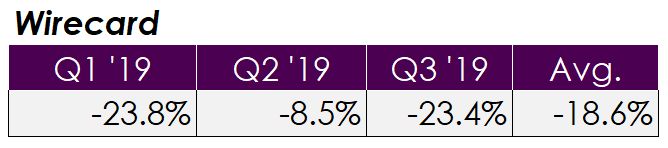
Note: D.A.T.A. Scores range from -100% (extremely deceptive) to +100% (extremely truthful).
Conclusion
Using a combination of deception science and Natual Language Processing (NLP) investors are able to surface deception. This is especially in private market transactions where investors are disadvantaged relative to public market investors. Relative to Wirecard, Clients of D.A.T.A. would have had a 3-month jump on McKinsey, a 6-month jump on Wirecard’s auditors, and a 9-month jump on all other investors.

0 Comments