


Here is the latest in our series of articles entitled, Key Scientific Paper Redux. This time out we examine Who can best catch a liar? A meta-analysis of individual differences in detecting deception.[i] This key paper addresses one of the issues raised by so many who believe the pan-cultural fictions about how deception ought best to be detected, as well as the idea that “professionals” are better at it than lay-people.
Like other key papers in deception science, Who can best catch a liar? Is a meta-analysis. You may recall from some of our earlier articles in the series that at Deception And Truth Analysis (D.A.T.A.) we prefer meta-analyses. The reason is that we can draw more confident conclusions based on the findings because the sample sizes are so large.
Who can best catch a liar?: Study Details
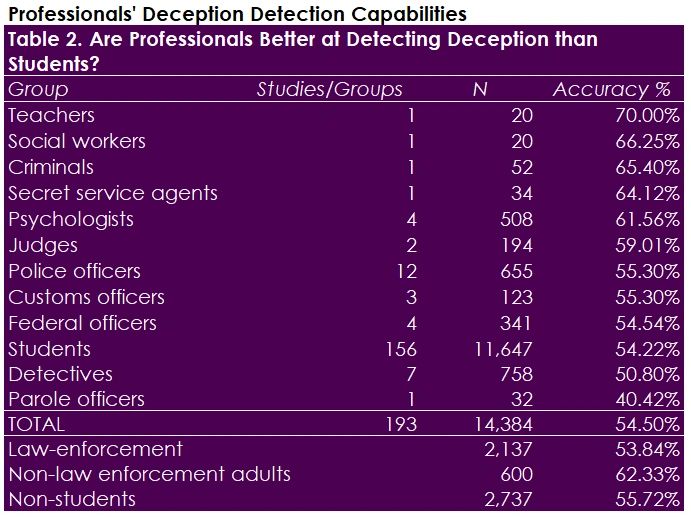
Aamodt synthesized research results from 108 deception judgment studies, covering the deception detection abilities of 16,537 people. Of this number, there were 11,647 students (as is typical for social psychology studies), 2,737 non-students, and 2,137 law enforcement professionals. Note: this is a smaller sample than was used in Bond and DePaulo, but is still gigantic. What makes this analysis unique and why we love it at D.A.T.A. is its examination of possible “star” deception detectors among professionals, such as law enforcement.
Who can best catch a liar?: Major Findings
- People’s overall accuracy in deception-truth judgments = 54.50%. This figure is almost exactly the same as was found in Bond and DePaulo, who found a 54.45% accuracy. Though the studies under examination are not entirely the same.
- Students’ deception detection accuracy = 54.22%.
- Law enforcement professionals = 53.84%.
- Non-law enforcement adults = 62.33%.
- Professionals deception detection accuracy = 53.84%.
- People’s confidence in their deception detection accuracy correlated with their actual deception detection accuracy = 5% (!).
As you can see from the above findings, law-enforcement, whom many consider to be deception detection pros, are actually worse at deception detection than the general population, students, and most interestingly, non-law enforcement adults. The following table contains the pertinent data:
Accuracy of Deception Judgments: Sub-Findings
- Correlation of age with deception detection = -3%.
- Correlation of “experience” with deception detection = -8% [experience is placed in quotes, because as our earlier articles demonstrate, most people, including law enforcement rely on deception detection techniques that do not work.]
- Correlation of education with deception detection = 3%.
- Among personality characteristics, the only characteristic that shows promise is self-monitoring (metacognitive) behavior, with a correlation of 14%.
- There is not a significant difference in the abilities of women and men in deception detection.
Quote of Note
“The results of this meta-analysis suggest that such individual differences as age, education, law enforcement experience, confidence, and sex are not related to the ability to detect deception.”
[i]Aamodt, Michael G. “Who can best catch a liar? A meta-analysis of individual differences in detecting deception.” The Forensic Examiner (Spring 2006)

0 Comments