


There are five major due-diligence steps in almost every investment process. They are:
- Establishing your investible universe.
- Relying on high-level criteria to identify state changes.
- Deeper dive analyses that establish an investment thesis.
- The buy-sell decision.
- Ongoing due-diligence of your investments.
Deception And Truth Analysis (D.A.T.A.) provides a powerful assist in each of the above steps. These Use Cases are the focus of our new five blog posts as we consider each of these steps, in turn. First up this week we show how to use D.A.T.A. in establishing your investible universe.
Mandates
For most investment firms their mandate – or contract between themselves and their clients – is the bedrock of establishing the investible universe. In public market investing, due to the prevalence of “investment style,” the investment universe is pre-ordained based on the permitted market capitalization of the underlying securities, as well as whether or not research analysts and portfolio managers are “growth,” “core,” or “value” investors.
Even pure quant investors typically narrow their mandates down to something digestible. But even in private markets the mandate drives the investible universe at a high level. For example, venture capitalists may narrowly focus on biotechnology companies that are at a “pre-seed” or “seed” stage. Private equity firms may only focus on industrial real estate in Canada, and so on.
Mandates ensure alignment between the presumed skill of the investment manager and their clients. Not only is the investment process made easier, but marketing is made easier, too.
For the most part these lists of securities dictated by an investment firm’s mandate are static. Unless there are new entrants into the space, the list of maximum investment possibilities does not change much. However, most firms then apply additional criteria to narrow down their list to something more manageable, and this is where Deception And Truth Analysis comes in.
Using DATA Scores to Refine the Investible Universe
Most investment managers take the maximum investible universe and further narrow it down. This is down to ensure that the number of companies and securities evaluated is digestible. But the other goal is to use high-level criteria to ensure that each of the companies and securities in the investible universe have a higher than chance probability of generating excess returns.
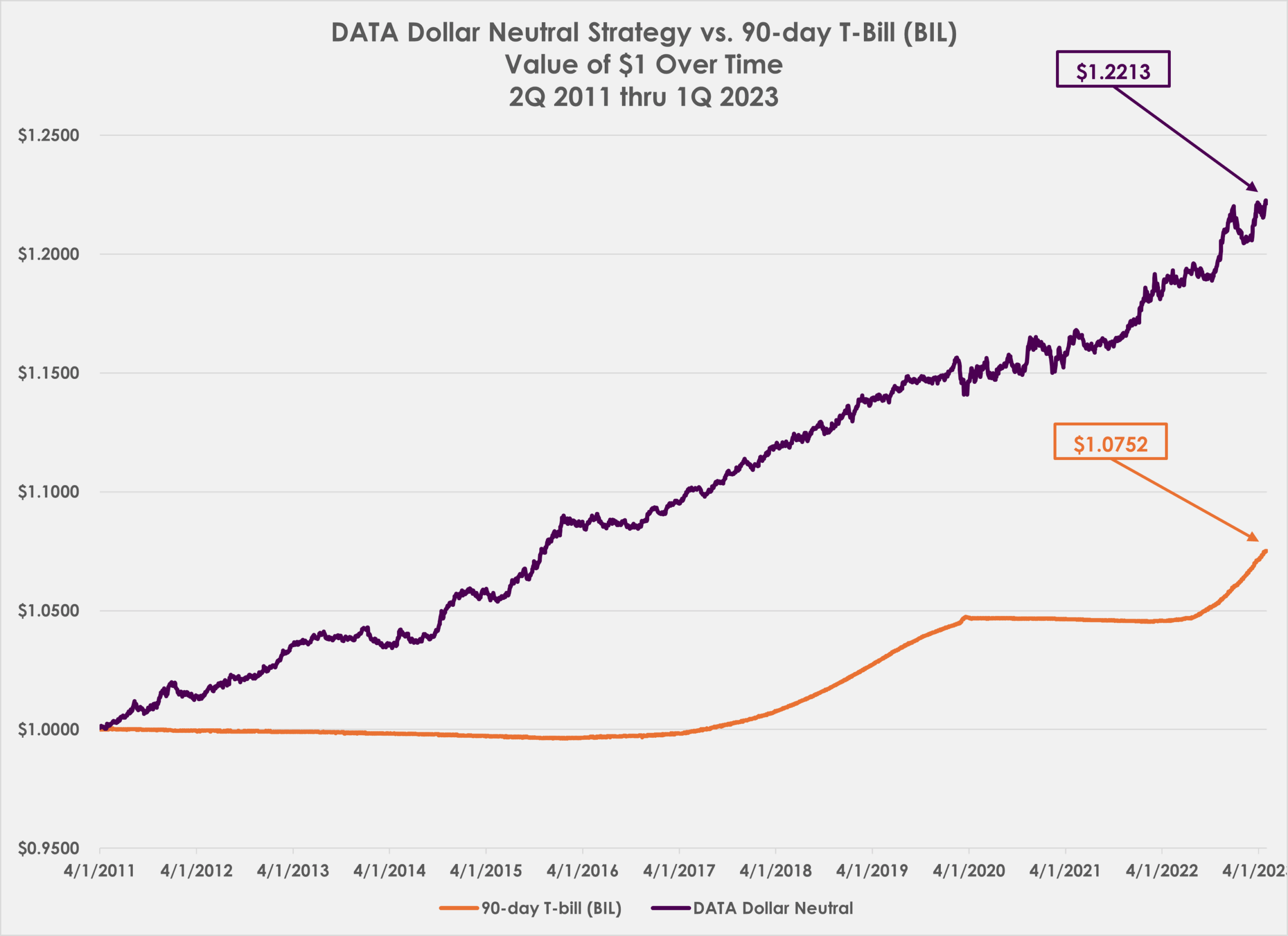
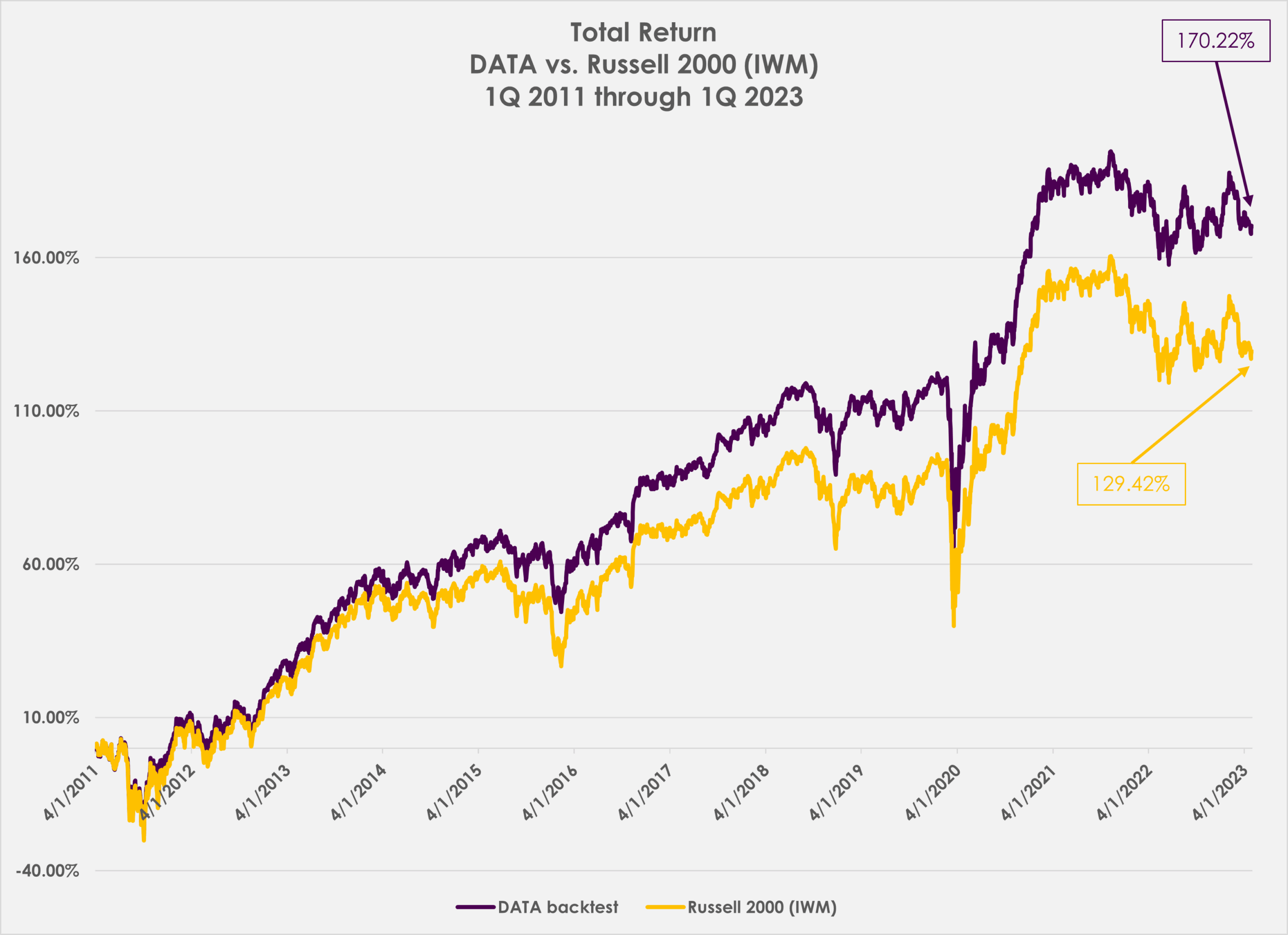
As Deception And Truth Analysis has demonstrated on multiple occasions our primary output, DATA Scores, are predictive of future stock price performance. Companies’ documents assessed by us as deceptive in the aggregate tend to underperform over the next 1-2 years. While companies’ documents assessed by us as truthful in the aggregate tend to outperform.
Our theory as to why DATA Scores are consistently predictive of future stock price performance is that companies whose operating performance is excellent cannot wait to tell the world about their results. By contrast, companies whose operating performance is underwhelming want to put a spin on their results to manage investor expectations.
So, it makes sense to filter out the companies from the indices with deceptive/negative DATA Scores, right? When we apply this very simple criterion…
a. Start with an index.
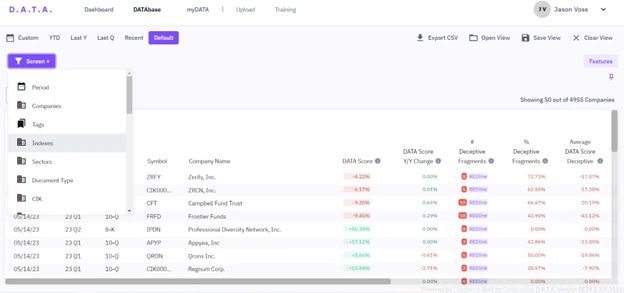
b. Narrow it to only those companies whose DATA Scores are truthful/ positive.
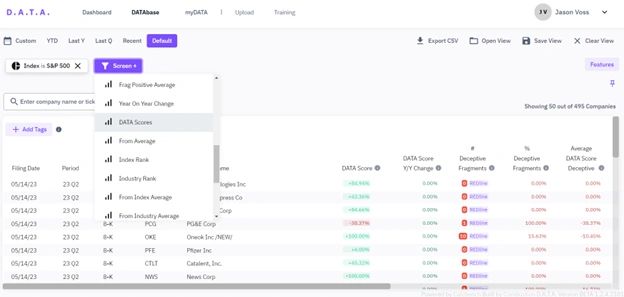
and…
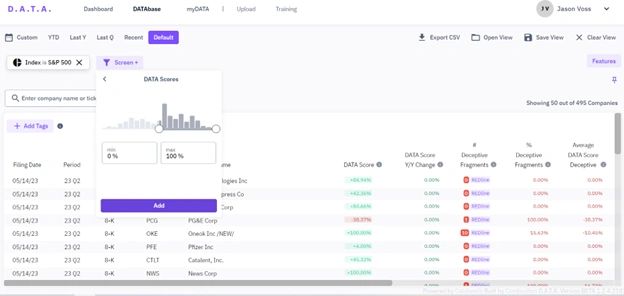
…we get the following results:
- S&P 500 narrows to 289 companies (see image below).
- S&P 400 narrows to 230 companies.
- S&P 600 narrows to 343 companies.
- Russell 2000 narrows to 1,043 companies.
- Russell 1000 narrows to 594 companies.
- Russell 3000 narrows to 1,637 companies.
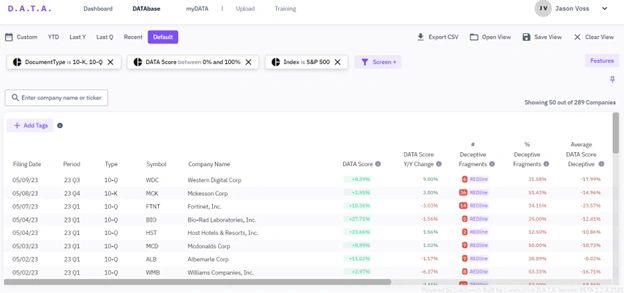
This may not seem like a huge improvement, but because our DATA algorithm has been double-blind, scientifically tested at 88.4% accuracy in discriminating between deceptiveness and truthfulness in documents then you can be strongly assured that the investible universe of companies narrowed down by DATA Scores has the following key characteristics at a greater than 50:50 chance of:
- Outperformance; and this is before any of your other criteria are applied.
- Downside protection; this is due to the elimination of deceptive companies from the investible universe.
- Lower ESG risk; due to the elimination of almost all of your G, governance, risk.
Conclusion
Deception And Truth Analysis is a force multiplier that allows investors and due-diligence pros to rapidly surface actionable investment insights. One powerful Use Case is to use DATA Scores to establish your investible universe. Because DATA Scores are predictive of future outcomes this increases your chances of outperformance.

0 Comments