


The Truth About Deception Detection by Body Language
Unfortunately, most who believe in the power of body language for surfacing deception, these beliefs have been tested hundreds of times over many decades. As reported in the largest meta-analysis of its kind (n = 24,483), the net result of these studies is that people globally are just 54% able to detect deception by relying on body language (source: Bond, Jr., Charles F. and Bella M. DePaulo. “Accuracy of Deception Judgments.” Personality and Social Psychology Review (2006) Vol. 10, No. 3: 214-34). That is just slightly better than chance.
Worse still is that figure is the overall success rate of discriminating between deception and truth. The composition of that 54% success rate is a paltry 47% detection rate for deception and a 61% success rate in detecting truth. In other words, people have an inherent truth bias. In turn, this makes us vulnerable to deception because most of us, on average, trust the statements made by other people.
Another independent study (see Table 2, below) places the global deception detection success rate at 54.22% (n = 11,647). With sample sizes of these kinds, you can confidently reject the notion that body language and other non-verbal cues are how you detect deception.
Individual cues have been exhaustively tested, and their success rate at deception detection is abysmal. Nevertheless, here is a summary of a few major cues which have been studied:
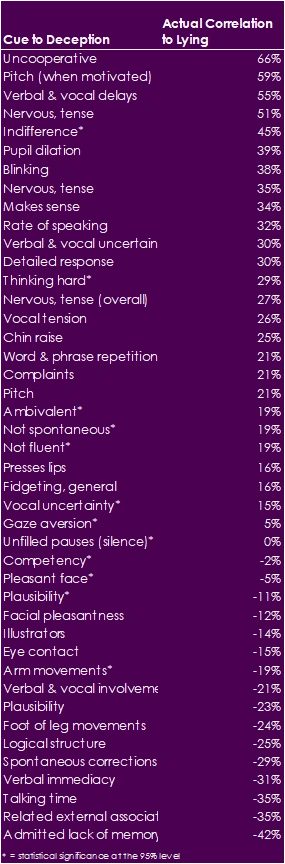
Our apologies for the length of the list, but we believe it is important to educate due-diligence pros reliant on people’s statements that they need better equipment than body-language and non-verbal cues to deception.
Here are some interesting things to note about the various body language and other non-verbal cues:
- Only 4 of the 43 non-verbal cues to deception have correlations to lying of greater than 50% and none are statistically significant. That is, their effects may be random.
- A large majority of the non-verbal cues to deception, 39 of 43, have correlations less than 50% with lying. It would be very difficult to rely on a non-verbal cue that is rarely associated with lying.
- Only 12 of the 43 non-verbal cues to deception are statistically significant, but their correlations are less than 50%. This means they are unreliable in attempting to discriminate between deceptiveness and truthfulness.
- Several of the cues that have been studied multiple times actually show wide divergence in their correlations. For example,
- Nervous, tense has been measured as correlating with lying 51%, 35%, and 27%.
- Pitch; 59% and 21%
- Plausibility; -11%* and -23% [found statistically significant once, but not a second time]
- Vocal uncertainty; 55%, 30%, 26%, 15%, -21%, -31%
Regarding #3, above, the range of values found likely means that these cues are very difficult to define by both the deception detector and the scientists trying to measure their success. For example, does anyone have a rock-solid and consistent definition of “vocal uncertainty” or “nervous, tense” or “plausibility?” This may account for the varied correlations measured.
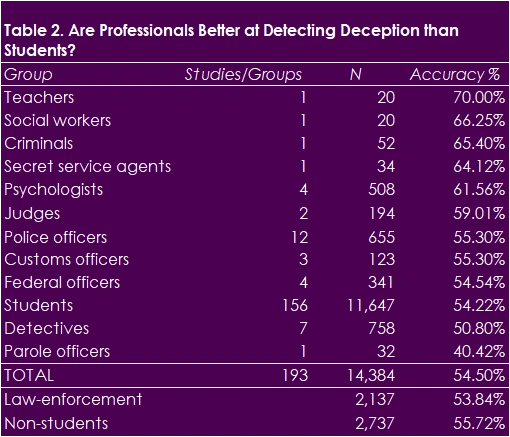
“Experts” Are Not Better
Now we know what you are thinking: Surely there are superstars, or with training, people can better discern truths from deception via body language. This also is not true. In fact, presumed experts such as law enforcement have all been tested. What researchers have found is that their abilities are just 55.72%. Yes, better than lay-people, but just slightly.
Most of us likely believe that law enforcement is the best at such capabilities. But they are just 53.84% accurate at deception detection. Cops are worse than the gen-pop. You would not want to make a multi-million-dollar investment based on this kind of “training.”
Conclusion
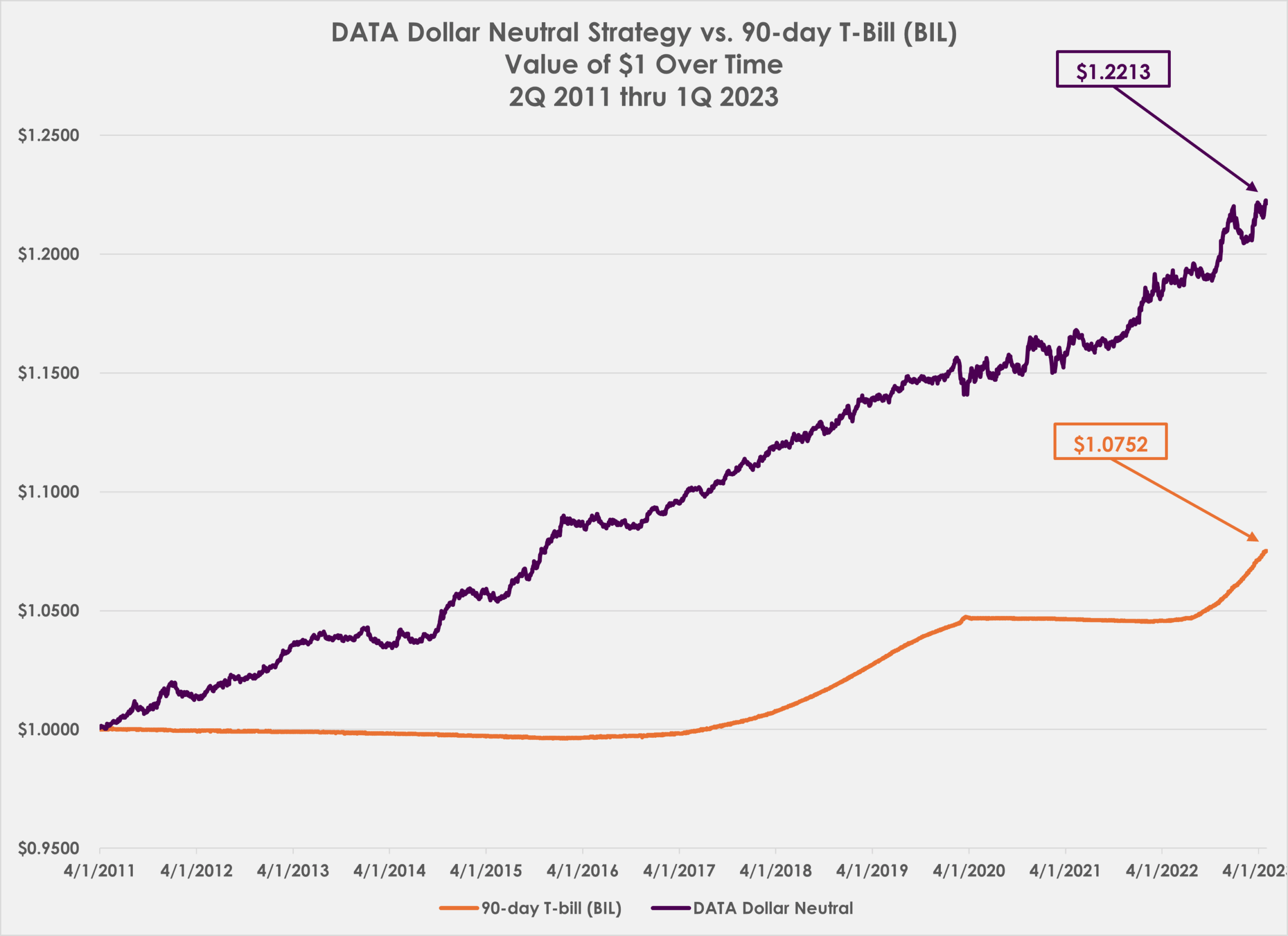
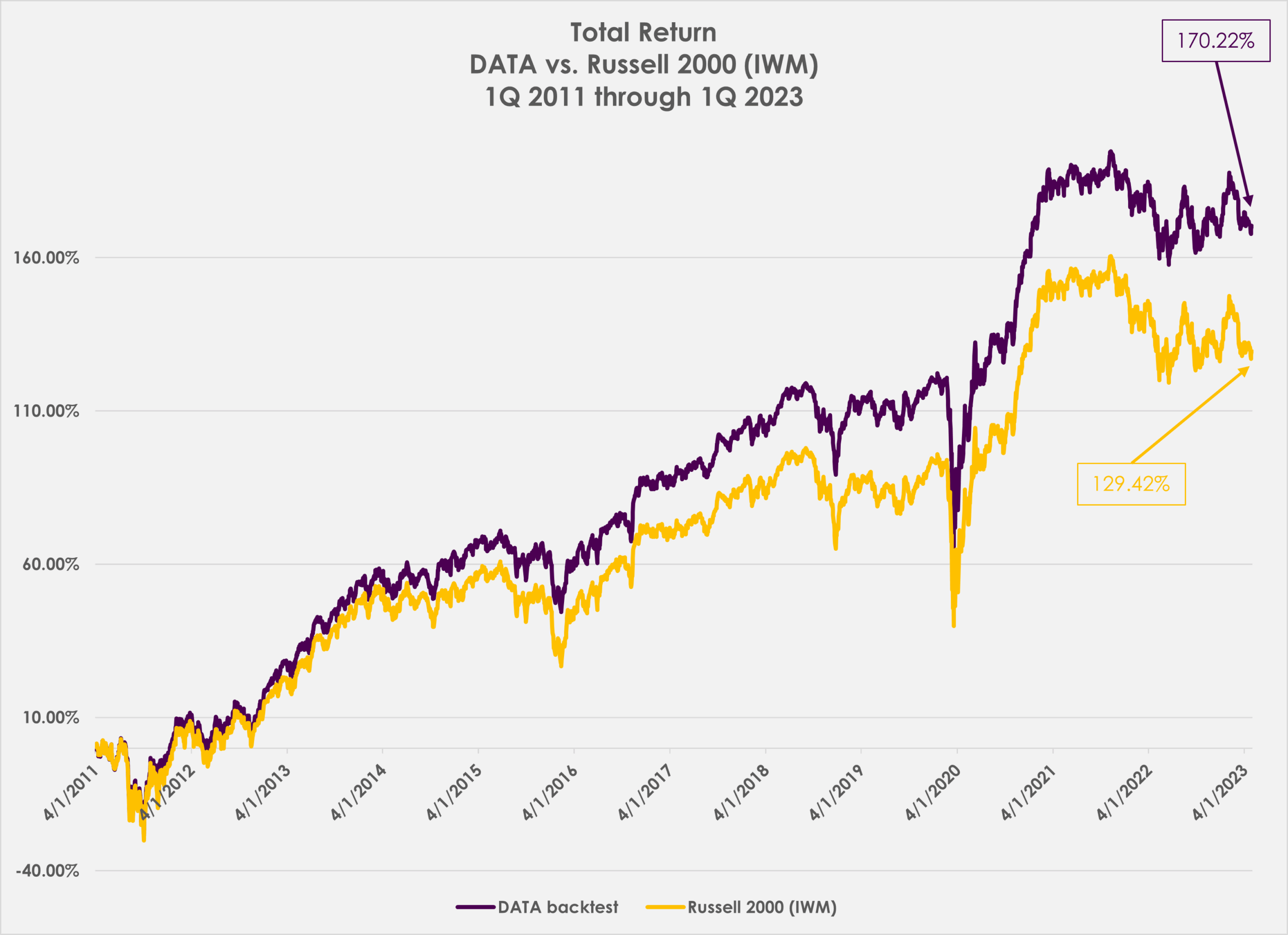
We should accept that detecting deception using body language cues does not work and may lead to wrongful convictions. We just are not good at detecting deception. This is especially true if we have bought into the pan-cultural fiction that body language is the best way to detect deception. Instead, due-diligence pros relying on the statements made by others need scientifically grounded deception detection methods, such as the methods developed at Deception And Truth Analysis (D.A.T.A.).

0 Comments