
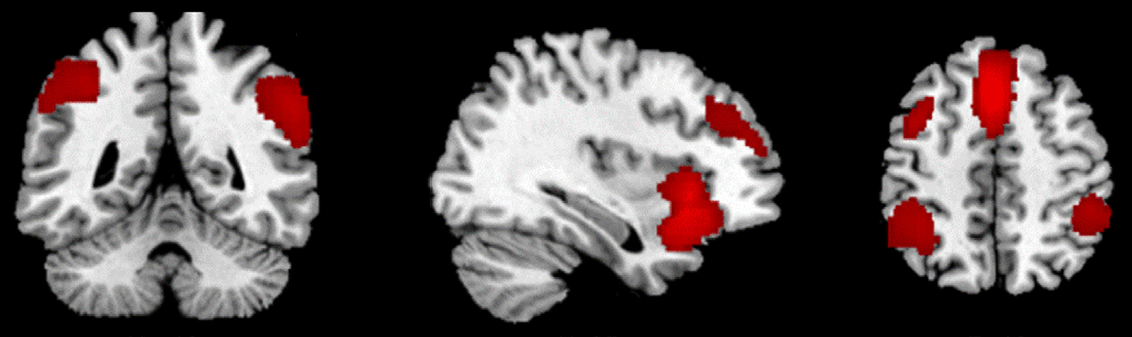

Is there a unique brain signature to deception? How neurologically do we manage the job of deceiving others? Can the findings of neuroscience provide insights for investment pros who look for the truth of the world each day? Each of these questions are answered by a review of The Neuroscience of Deception. Stay tuned to the end when we discuss some of the recommended strategies for utilizing these insights in your own work.
Deceiving Takes Brain Power
In deception science researchers have long known that lying is generally more cognitively demanding. Neuroscientists affirm this and have found that deceiving is cognitively complex and involves:
- Awareness of your own and others’ thoughts.
- Generation of invented/deceptive statements.
- Inhibition of normal responses, such as telling the truth.
- Repeated task switching, including ongoing monitoring of conversations and narratives, and the updating of responses.
- A person’s motivations for deceiving.
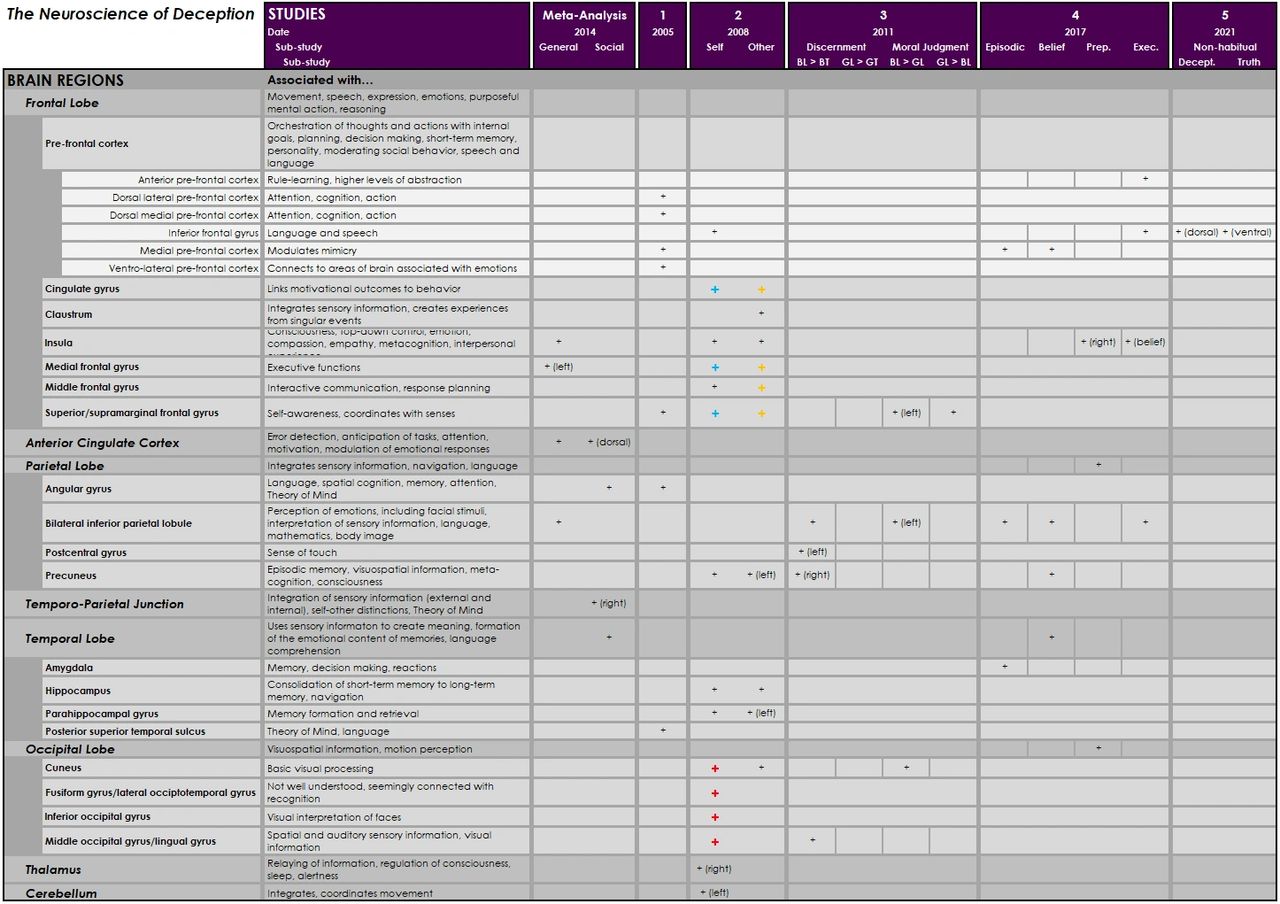
This list serves as a form of hypothesis for the studies described below. We ought to see brain regions activated that are associated with the above mental tasks. This article explores some of the more interesting neuroscientific work done on deception since 2005. Below we provide what we think is a very interesting graph that shows side-by-side the different brain regions involved when people tell the truth and when they engage in deception.[i]
Study 1 – What happens when we increase the stakes of being caught deceiving?
Not surprisingly, some of the first neuroscience of deception studies found brain regions associated with the above list are indeed activated while deceiving. However, a criticism of these early studies is that the stakes for the deceivers were not very high. If the stakes for lying are higher then the liars are motivated to convince. If they are motivated to convince, then the differences in their behaviors and brain region activation ought to stand in starker contrast with those of truth tellers.
Unique in the approach of Study 1[ii]was inducing a level of anxiety in the study participants by telling them that their brain activity was being monitored. Indeed, subjects in Study 1 did report feeling increased anxiety when deceiving.
When the brains of deceivers were compared directly with truth tellers the imaging results attained saw increased activity in brain regions collectively implicated in a variety of cognitive tasks (see our Table, below). Specifically, brains regions associated with higher executive functions such as working memory, planning, task switching and updating, and cognitive control.
Furthermore, this combination of regions is thought to be a kind of “circuit” critical for inhibitory control over a person’s reactions and for monitoring conversational narratives versus facts. Obviously, this matches pretty well with deceptive behavior because it is the intentional denial of or withholding of truth.
Study 2 – Are there neurological differences when people deceive about themselves vs. others?
Let’s face it, not all lies are the same because not all situations are the same. Sometimes we deceive others about ourselves, and sometimes we deceive about other people. So, are there neurological differences when people are deceiving about themselves versus others? It turns out that there are, as Study 2[iii]illustrates.
Researchers found that there is overlap in the brain regions involved in deceiving others about ourselves as well as lies told about other people. Interestingly, they found that deceptions about ourselves involve more brain regions than those we tell about others. The only exception is that when we deceive about others the brain region associated with integrating sensory information to better comprehend the world is activated.
Among the other key findings is that deceiving seems to involve entire brain networks that work in concert to manufacture deceit. When we tell lies about ourselves regions associated with using our senses to track our surroundings (red +s in table, below), self-awareness, and goal monitoring are at play (blue +s in table, below).[iv]
A similar network was found active for deceptions told about others with the additional key brain region of response planning involved.[v]Unlike deceptions told about ourselves, the network that involves using our senses to monitor our surroundings was not in play (orange +s in table, below). This might suggest that we experience greater duress when telling lies about ourselves, such that we feel compelled to check our surroundings to make sure that we are safe. This suggests a possible strategy for improving deception detection which we discuss below.
Study 3 – What happens neurologically when we are attempting to detect deception?
Deception involves two parties: a deceiver and a receiver. What happens neurologically for those attempting to discern whether the messages they are receiving are deceptive?[vi] Further, what about the effect of different social contexts on our ability to discriminate between deception and truth?
As an example of different social contexts, in Western cultures, the majority of deceptions are told to spare another person’s feelings, such as “Yes, you look good in that shirt.” Whereas, in Eastern cultures, the majority of deceptions diminish a person’s own achievements and create a sense of humility.
Fascinatingly, behavioral studies of Asians have repeatedly shown that they rate telling the truth about your own good deeds lower than the value of telling the truth about your antisocial acts.[vii] This shows that the social context matters when attempting to detect deception.
Are these different social contexts present at the neurological level for those seeking to detect deception? To answer these questions the scientists compared the following different social contexts:
- Bad act lies, such as: “Did you break this? No.” [BL]
- Bad act truths, such as: “Did you break this? Yes.” [BT]
- Good act lies, such as: “Did you tidy up the classroom? No.” [GL]
- Good act truths, such as: “Did you tidy up the classroom? Yes.” [GT]
When brain activation was greater in deception detectors for “bad lies” vs. “bad truths” it was regions of the brain having to do with consciousness and perception (see table below). In other words, those seeking to detect deception felt something was amiss. We will discuss this insight and how to take advantage of it below. By contrast, when deception detectors were told social lies there were no brain regions more activated than when they are told “good truths.”
What about when judging something morally such as a deception detector and their response to a “bad lie” vs. a “good lie?” The areas of the brain activated in these situations had to do with visual perception and reading the face. Long-time readers of our deception science work will know that this comports with someone relying on body language cues to try and detect deception. Sadly, body language cues do not work for detecting deception and remains a pan-cultural fiction.
When a deception detector is confronted with a “good/social lie” the only part of the brain that is activated differently than normal is that having to do with self-awareness.
Study 4 – Does the Brain Activate Differently Depending on the Type of Lie?
A frequent finding in neuroscience studies of deception is that the brain regions that are more active when deceiving are those associated with cognitive control, such as the frontal and parietal cortices. Additional activations are those associated with evaluating social contexts, such as the superior temporal cortex and temporal poles.
To advance deception science this study[viii]sought to research whether there are neurological differences:
- That depend on the type of information being conveyed when deceiving. Specifically, the researchers examined deception when recalling episodic memories or expressing opinions.
- When preparing to deceive versus when engaged in the deceptive act.
By the way, we would be remiss in not mentioning that research question #1, above, is directly related to our previous article on Reality Monitoring. Namely, it has been shown that most people’s memories about things they have experienced (i.e. episodic memory) is more reliable than their memories about their opinions. It seems that if the senses are engaged it is easier to remember something. This in turn, has ramifications for those seeking to improve their deception detection.
What did the scientists find? When deceivers are attempting to lie about something they actually experienced their brains are more activated in the parts having to do with memory, decision-making, and reactions. When lying about their opinions, deceivers’ brains were more activated in parts that control self-awareness and turning sensory signals into something they may comprehend. For both types of deceptions, parts of the brain having to do with mimicry, facial stimuli, language, and body image were more activated than normal.
It turns out that the researchers’ instincts that there are different brain regions involved in preparing to deceive, as opposed to actually deceiving, were correct. When preparing to deceive the brains were more activated in areas having to do with consciousness, self-control, interpersonal experience, and perception. By contrast, when engaged in the deceptive act researchers found brain regions associated with abstract thinking, language, facial stimuli, and body image active.
Study 5 – Does it Really Require More Brain Power to Deceive?
Neuroscientists have debated the role of cognitive control in deception. Specifically, is it the case that honesty is automatic, or does it require willpower in the form of cognitive control to overcome an automatic dishonest response?
In this study[ix]scientists found that the cognitive control regions typically found in deception studies both help normally honest people to deceive, and to help normally dishonest people to behave honestly. In other words, cognitive control depends on a person’s moral default. If you are behaving against your personality type then it requires more cognitive control, otherwise it does not. This surprising finding stands in stark contrast to what was believed by most deception scientists to be true.
Deception Detection Strategies Suggested by the Neuroscience Findings
Based on the findings described above, what can we do about it as due-diligence pros? Here is a short list of suggestions based on the findings:
- Remind those you are questioning of the stakes of your questions. If you are an investor working in a fiduciary capacity it is important to remind others that you are trying to help other people.
- Increase the cognitive load. Deception requires a lot of brain power. Answering difficult questions is harder for deceivers than it is truth tellers.
- Pay attention to whether someone is more uncomfortable with a line of questioning having to do with themselves or with others.
- Trust your instincts. Researchers found that those attempting to detect lies sensed something was off. Sadly, they tended to trust body language cues. Don’t do that!
Good luck. Better skill!
Endnotes:
[i] One word of caution, though: almost all neuroscience studies feature very low numbers of participants because the studies are so expensive to run. The total number of subjects studied in the above studies is around 100. Thus, be conservative in drawing firm conclusions.
[ii] Luan Phan, K., Alvaro Magalhaes, Timothy J. Ziemlewicz, Daniel A. Fitzgerald, Christopher Green, and Wilbur Smith. “Neural Correlates of Telling Lies: A Functional Magnetic Resonance Imaging Study.” Academic Radiology, Vol. 12, No. 2, February 2005: 164-172
[iii] Ganis, Giorgio, Robert R. Morris, and Stephen M. Kosslyn. “Neural processes underlying self- and other-related lies: An individual difference approach using fMRI.” Social Neuroscience(2008): 1-15
[iv] Neurological network that drives deceptive behavior in deceptions about the self is: GC/GFd/GFs + GL/GOi/GF/GOm + thalamus = 94.9% of variance in response times explained.
[v] Neurological network that drives deceptive behavior in deceptions about others is: GFm/GFs + GC + GFm = 81% of variance in response times explained.
[vi] Wu, Dingcheng, Ivy Chiu Loke, Fen Xu, and Kang Lee. “Neural Correlates of Evaluations of Lying and Truth-Telling in Different Social Contexts.” Brain Research, 2011 May 10; 1389: 115-124
[vii] See, for example: Fu GY, Lee K, Cameron CA, Xu F. “Chinese and Canadian adults’ categorization and evaluation of lie- and truth-telling about prosocial and antisocial behaviors.” Journal of Cross-Cultural Psychology. 2001; 32: 720-727 & Lee, K, Xu F, Fu G, Cameron CA, Chen S. “Taiwan and Mainland Chinese and Canadian Childrens’ categorization and evaluation of lie- and truth-telling: A modesty effect.” British Journal of Developmental Psychology. 2001; 19:525-545
[viii] Ofen, Noa, Susan Whitfield-Gabrieli, Xiaoqian J. Chai, Rebecca F. Schwarzlose, and John D.E. Gabrieli. “Neural correlates of deception: lying about past events and personal beliefs.” Social Cognitive and Affective Neuroscience, 2017, 116-127
[ix] Speer, Sebastian P.H., Ale Smidts, and Maarten A.S. Boksem. “Different Neural Mechanisms Underlie Non-habitual Honesty and Non-habitual Cheating.” frontiers in Neuroscience 9 February 2021, Vol. 15

0 Comments