


This is our second article providing an overview of Use Cases for Deception And Truth Analysis. In this article we cover Identifying State Changes to ensure that you are not caught off-guard in your investment research or due-diligence. In other words, D.A.T.A. can help you identify very early when either storm clouds are gathering, or when a company is emerging from a previous stormy period.
As a review, there are five major due-diligence steps in almost every investment process. They are:
- Establishing your investible universe.
- Relying on high-level criteria to identify state changes.
- Deeper dive analyses that establish an investment thesis.
- The buy-sell decision.
- Ongoing due-diligence of your investments.
Deception And Truth Analysis (D.A.T.A.) provides a powerful assist in each of the above steps.
DATA Score Y/Y Change
Recall that our DATA Scores are predictive of future stock prices, on average. Because of this, investors ought to focus on identifying state changes in a company’s documents’ DATA Scores as represented by our year on year change, “DATA Score Y/Y Change.”
For example, Fair Isaac Corporation (ticker: FICO) recently saw a dramatic change in its DATA Score for its first quarter 10(q). Last year’s 2022 document had a DATA Score of 23.95%; or Truthful by more than one standard deviation. By contrast its 2023 10(q) has a DATA Score of 1.86%, or just barely Truthful.
This change is enough to move it being the most truthful firm in the US midcap space, to being in the bottom quartile. To put this in perspective, at the time of this writing our DATAbase coverage universe includes 4,960 companies and this change is the 15th worst.
Again, because DATA Scores are predictive of future stock prices, on average, if Fair Isaac is in your coverage universe then you have strong evidence that something dramatic has happened. Having identified this state change you should dig deeper.
Our DATAbase REDline premium product allows you to do just that. Because of D.A.T.A.’s ability to rapidly surface actionable investment insights we are a force multiplier for your work. In just two clicks you can easily see that FICO’s most deceptive fragment in its 2023 Q1 10(q) regards the company’s annual recurring revenues (see below).
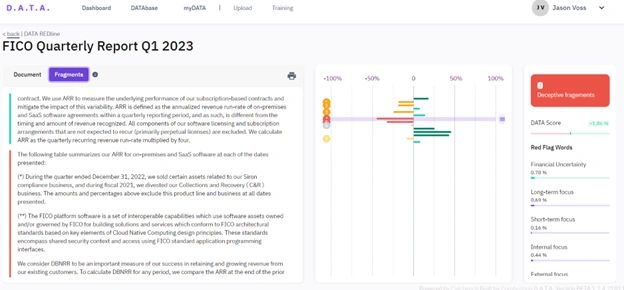
Equipped with this information you can now dig a little deeper into what is happening at FICO. Furthermore, you can ask better questions of management at the company to ensure that any concerns you have are addressed.
Last, and as an aside, the number of pages in FICO’s 2023 10(q) have significantly dropped from over 90 pages in 2022 to just 51.
Average DATA Score Deceptive/Truthful
Next up in terms of identifying state changes is looking at several additional D.A.T.A. outputs, namely:
- % Deceptive Fragments
- Average DATA Score Deceptive
- % Truthful Fragments
- Average DATA Score Truthful
As an example, let’s focus in on Deep Green Waste & Recycling, Inc. (ticker: DGWR). First, its DATA Score Y/Y Change for its Q1 2023 10(q) is -16.93%, while its DATA Score is -6.29%. In other words, DGWR has switched from being a truthful company to a deceptive company in just one year’s time. But let’s dig in a little deeper.
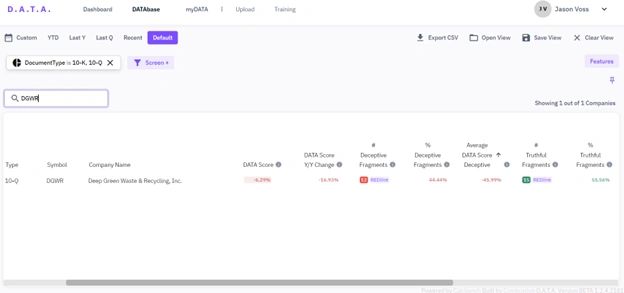
For DGWR it has the following D.A.T.A. outputs for its first quarter 2023 10(q):
- % Deceptive Fragments = 44.44%
- Average DATA Score Deceptive = -45.99%
- % Truthful Fragments = 55.56%
- Average DATA Score Truthful = +22.17%
As you can see DGWR is being truthful more than half of the time in its document, or 55.56% of the time. While this assessment may be comforting, as you can see from the figures above, when DGWR is being deceptive their deception is twice the magnitude (-45.99%) as when they are being truthful (+22.17%).
When these D.A.T.A. outputs are coupled with the DATA Score Y/Y Change, a picture rapidly emerges that helps investors to rapidly identify state changes in companies, and to identify actionable investment insights. If you are curious about DGWR, DATAbase REDline reveals that the company appears to have had a change in CEO and the fragments in which they are being most deceptive have to do with a raft of equity issuance at the company.
Perhaps the equity issuance is in response to these change in the C-suite. But maybe they are not. Deception And Truth Analysis is a screening tool and not a diagnostic. In other words, equipped with our analytics you now have a force multiplier effect that allows you to rapidly surface actional investment insights.
Getting Creative
As a Client of D.A.T.A.’s you can access our analytics via API or .csv export among multiple methods. It is entirely possible that you can set up a screen for yourself in which you set a pain threshold in terms of the DATA Score Y/Y Change that you are looking for. These could include:
· Any change that moves a company from a truthful/positive DATA Score to a deceptive/negative DATA Score.
· Any absolute % change that is greater than |10%|.
· And so on.
Furthermore, you could also set up your own ratios that relate our analytics to one another in a meaningful way. For example, you could set up a ratio that is something like: (% Truthful Fragments x Average DATA Score Truthful) dived by (% Deceptive Fragments x Average DATA Score Deceptive). You may conduct your own tests of the predictability of this ratio and find that any ratio greater than 1.2 is strongly predictive of future stock price returns.
The possibilities are numerous, and we encourage you to have some fun!
Conclusion
Deception And Truth Analysis’ analytics, including ‘DATA Score Y/Y Change,’ ‘% Deceptive Fragments,’ ‘Average DATA Score Deceptive,’ ‘% Truthful Fragments,’ and ‘Average DATA Score Truthful’ all provide valuable means of identifying state changes in companies’ documents. Using these D.A.T.A. analytics is a force multiplier that allows you to rapidly surface actionable investment insights. This is true because DATA Scores are predictive of future business outcomes, and usually stock prices, too.

0 Comments