


Third among Deception And Truth Analysis’ Use Cases articles, here we cover the deep dive securities analysis enabled by our platform for our Clients. These include things such as:
- What are the key issues that a company is being either deceptive or truthful about
- When do the key issues first express themselves?
- What key issues identified by D.A.T.A. affirm my investment thesis? Which key issues disaffirm by investment thesis?
As a review, there are five major due-diligence steps in almost every investment process. They are:
- Establishing your investible universe.
- Relying on high-level criteria to identify state changes.
- Deeper dive analyses that establish an investment thesis.
- The buy-sell decision.
- Ongoing due-diligence of your investments.
Deception And Truth Analysis (D.A.T.A.) provides a powerful assist in each of the above steps.
Case Study 1: Fair Isaac Corporation
In Part 2 of this Use Case series we used the “DATA Score Y/Y Change,” the year on year change in Deception And Truth Analysis (DATA) Score to identify that something problematic seems to be happening at Fair Isaac Corporation (ticker: FICO). Specifically, the company saw a dramatic drop in its DATA Score for its first quarter 10(q) of 22.09% as compared with the first quarter 10(q) of 2022. This change was enough to move FICO from being assessed by DATA as the most truthful of midcap software companies, to just barely truthful with a DATA Score of just 1.86%.
Subscribers of both Deception And Truth Analysis’ DATAbase product and DATAREDline premium product are able to see the interior run of deceptiveness and truthfulness within a document. Below is the REDline view of FICO’s 2023 10(q). As you can see by looking at the REDline view in the middle of the screenshot below, the seventh fragment is unambiguously the most deceptive fragment. In fact, its DATA Score of -44.8% places it 3.7 standard deviations below the mean DATA Score of 6.02%. In other words, the information in this fragment scores as highly deceptive.
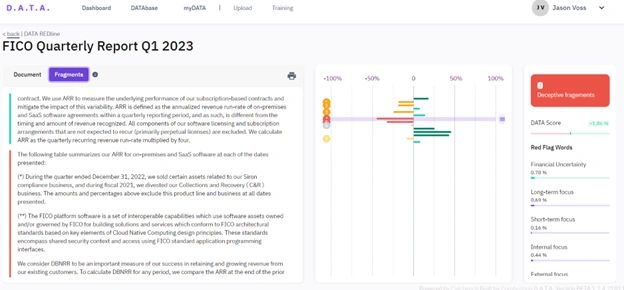
Here is the FICO 2023 first quarter 10(q) text making up that fragment:
“The following table summarizes our ARR for on-premises and SaaS software at each of the dates presented:
[Footnote of Annual Recurring Revenue Table]
“(*) During the quarter ended December 31, 2022, we sold certain assets related to our Siron compliance business, and during fiscal 2021, we divested our Collections and Recovery ( C&R ) business. The amounts and percentages above exclude this product line and business at all dates presented.
[Footnote of Annual Recurring Revenue Table]
“(**) The FICO platform software is a set of interoperable capabilities which use software assets owned and/or governed by FICO for building solutions and services which conform to FICO architectural standards based on key elements of Cloud Native Computing design principles. These standards encompass shared security context and access using FICO standard application programming interfaces.
“We consider DBNRR to be an important measure of our success in retaining and growing revenue from our existing customers. To calculate DBNRR for any period, we compare the ARR at the end of the prior comparable quarter ( base ARR ) to the ARR from that same cohort of customers at the end of the current quarter ( retained ARR ); we then divide the retained ARR by the base ARR to arrive at the DBNRR. Our calculation includes the positive impact among this cohort of customers of selling additional products, price increases and increases in usage-based fees, and the negative impact of customer attrition, price decreases, and decreases in usage-based fees during the period. However, the calculation does not include the positive impact from sales to any new customers acquired during the period. Our DBNRR may increase or decrease from period to period as a result of various factors, including the timing of new sales and customer renewal rates.
“The following table summarizes our DBNRR for on-premises and SaaS software for each of the periods presented:
[Footnote of Dollar-Based Net Retention Rate table]
“(*) During the quarter ended December 31, 2022, we sold certain assets related to our Siron compliance business, and during fiscal 2021, we divested our C&R business. The percentages above exclude this product line and business for all periods presented.
“RESULTS OF OPERATIONS
“We are organized into two reportable segments: Scores and Software. Although we sell solutions and services into a large number of end user product and industry markets, our reportable business segments reflect the primary method in which management organizes and evaluates internal financial information to make operating decisions and assess performance.
“Segment revenues, operating income, and related financial information, including disaggregation of revenue, are set forth in Note 8 and Note 12 to the accompanying condensed consolidated financial statements.
“Revenues
“Scores
“Scores segment revenues increased $8.5 million due to an increase of $11.9 million in our business-to-business scores revenue, partially offset by a decrease of $3.4 million in our business-to-consumer revenue. The increase in business-to-business scores revenue was primarily attributable to a multi-year license renewal, higher unit prices across several business-to-business offerings and an increase in unsecured credit originations volume, partially offset by a decrease in mortgage originations volume during the quarter ended December 31, 2022. The decrease in business-to-consumer revenue was primarily attributable to a decrease in direct sales generated from the myFICO.com website.
“Software
“Software segment revenues increased $14.0 million due to an $18.2 million increase in our on-premises and SaaS software revenue, partially offset by a $4.2 million decrease in services revenue. The increase in our on-premises and SaaS software revenue was attributable to a $9.4 million increase in our non-platform software revenue and an $8.8 million increase in our platform software revenue. The decrease in services revenue was primarily attributable to our strategic shift to emphasize software over services.
“Cost of Revenues
“Cost of revenues consists primarily of employee salaries, incentives, and benefits for personnel directly involved in delivering software products, operating SaaS infrastructure, and providing support, implementation and consulting services; overhead, facilities and data center costs; software royalty fees; credit bureau data and processing services; third-party hosting fees related to our SaaS services; travel costs; and outside services.
“The quarter-over-prior year quarter increase in cost of revenues of $7.4 million was primarily attributable to a $9.2 million increase in personnel and labor costs and a $0.5 million increase in travel costs, partially offset by a $2.2 million decrease in direct materials costs. The increase in personnel and labor costs was primarily attributable to increases in employee time allocated to cost of revenues and headcount. The increase in travel costs was primarily attributable to relaxed COVID-19 related restrictions. The decrease in direct materials costs was primarily attributable to a decrease in telecommunications costs to support FICO Customer Communications Services revenue and a decrease in credit bureau data costs associated with decreased business-to-consumer scoring solutions revenue through the myFICO.com website. Cost of revenues as a percentage of revenues increased to 22% during the quarter ended December 31, 2022 from 21% during the quarter ended December 31, 2021, primarily due to an increase in personnel and labor costs.
“Research and Development
“Research and development expenses include personnel and related overhead costs incurred in the development of new products and services, including research of mathematical and statistical models and development of new versions of Software products.
“The quarter-over-prior year quarter decrease in research and development expenses of $2.3 million was primarily attributable to a $2.8 million decrease in personnel and labor costs as a result of decreased headcount, partially offset by a $0.5 million increase in software royalty fees. Research and development expenses as a percentage of revenues decreased to 11% during the quarter ended December 31, 2022 from 12% during the quarter ended December 31, 2021.”
In summary, it appears to be the case that FICO is being deceptive primarily about its revenue performance. This insight was available to you in just several clicks using DATAbase and DATAREDline. In fact, we know from our clockspeed tests that we are more than 350x faster than people in assessing documents for their level of deceptiveness and truthfulness.
How to Use Fragments and Their DATA Scores
Equipped with the above information you can ask either better questions of management at the company to ensure that any concerns you have are addressed, or you can ask better questions of your underlying data and commensurate assumptions.
As an example of how to use this information is that since the fragment primarily has to do with revenues, investors can call FICO’s investor relations, or the controller, or the CFO and ask for greater granularity or explanation about revenue performance. Additionally, investors could identify who the top customers of FICO scores are and conduct their own channel checks to verify that FICO’s top customers are still utilizing FICO scores to the same degree.
Alternatively, investors could attempt to match the revenue picture to what they know about the number of mortgage or car loan originations. If an investor believes that the economy is slowing, and FICO is being deceptive about its revenue disclosures, then the investor could likely conclude that FICO is likely experiencing, but not acknowledging a slowdown in its business.
All of the above information could also be used by investors to alter their financial modeling of the business. If, for example, they agree with DATA that FICO is being deceptive about its revenues, then they can lower their expectations for revenue performance going forward. In turn, this is sure to affect the valuation of the company, too. This may even affect whether or not the investor continues to want to buy, or hold, shares in the company.
At the time of this writing, FICO’s stock price has risen to $789.30 from $401.81 a year ago. This is a rise of 96.4%. Interestingly, revenues grew only 1.6% in 2022 from 2021 levels. Meanwhile, net income grew just 3.4%.
Conclusion
Deception And Truth Analysis is able to rapidly surface actionable investment insights for teams. In just several clicks DATA is able to help you zero in on key information that does not seem to be priced into securities prices. This information can be used to sharpen your questions and also to make more informed investment decisions.

0 Comments